

MV Aerial Bundle Cable (ABC) Overhead
11KV 33KV Medium Voltage MV Aerial Bundled Conductor (ABC) XLPE Cables
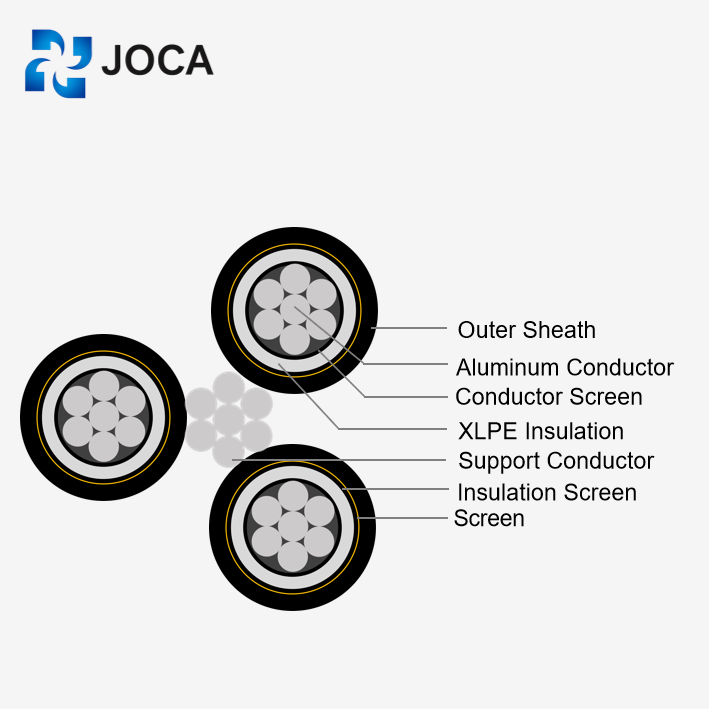
- Phase Conductor : Circular compacted stranded H68 aluminium to BS2627.
- Conductor Screen : Extruded semi-conductive layer.
- Insulation : XLPE.
- Insulation Screen : Extruded semi-conductive layer.
- metallic Screen(optional) : Copper wire screen or copper tape screen.
- Separator : Semi-conductive swellable tape.
- Outer Sheath : HDPE.
- Support Conductor : Galvanized steel wires.
- Fast Sample Processing with Customized Solutions
- High-Quality Materials
- Affordable Price Options
- Global Delivery
- For better data protection, make sure that all uploads are secure
Save at least 30% on average
Home » Aerial Bundled Cable » MV Aerial Bundle Cable (ABC) Overhead
-
Product Description
Aerial Bundle Cable : Product Description and Specifications
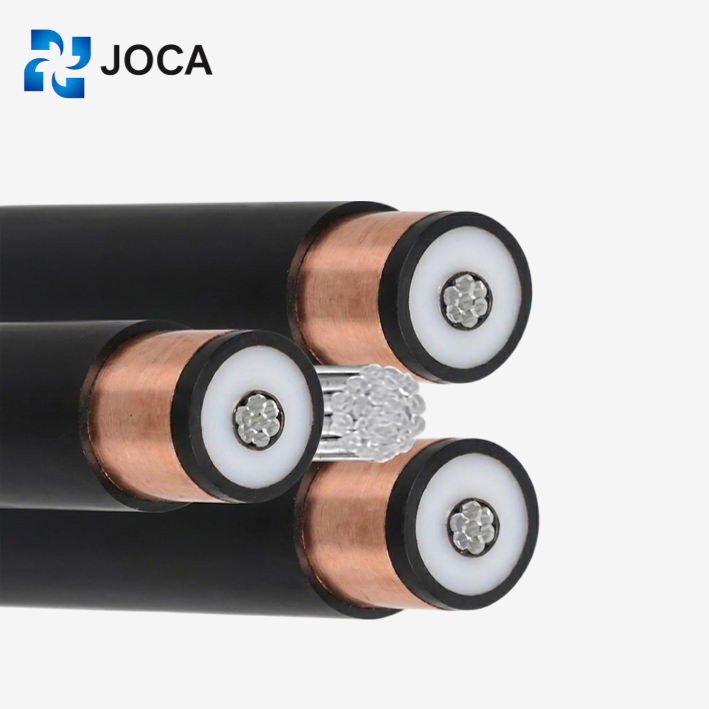
The Aerial Bundle Cable (ABC) series configures insulated overhead conductors for critical LV and MV distribution. Unlike legacy bare wire, this XLPE-insulated design (utilizing AAAC/1350-H19 aluminum) creates a safety-critical barrier, minimizing maintenance requirements. Application Scope: Ranges from 0.6/1kV service drops/lighting to 33kV primary feeders. Structural Options: Manufactured with either an integrated supporting messenger or self-supporting lay, depending on span engineering requirements.
-
Advantages
Aerial Bundle Cable : Benefits and Features
Grid Classification: 11kV / 33kV. (Medium Voltage Network).
Suspension Logic: Galvanized Steel Messenger. Provides the structural tensile core for Self-Supporting spans.
Spatial Geometry: Compact Bundled Assembly. Reduces visual footprint and easement width requirements compared to bare wire.
Field Stress Control: Dual Semi-Conductive Screens. Physically enforces radial field uniformity to eliminate partial discharge risks.
Sheath Chemistry: HDPE. Specified for high ESCR (Environmental Stress Crack Resistance) and aging immunity in outdoor weathering.
Specification Of Aerial Bundle Cable
| Cross section [mm²] | No. of wires | Conductor diam. [mm] | Overall Diameter [mm] | Minimum breaking load [kgf] | Approx. weight [kg/km] | Max. DC-resistance at 20°C [Ohm/km] | Ampacity 90°C [A] |
|---|---|---|---|---|---|---|---|
| 35 | 7 | 7.1 | 13.6 | 464 | 190 | 0.868 | 187 |
| 50 | 7 | 8.2 | 14.7 | 663 | 235 | 0.641 | 225 |
| 70 | 19 | 9.7 | 16.2 | 928 | 315 | 0.443 | 282 |
| 95 | 19 | 11.5 | 18 | 1259 | 400 | 0.32 | 345 |
| 120 | 19 | 12.9 | 19.4 | 1591 | 500 | 0.253 | 401 |
| 150 | 19 | 14.2 | 20.7 | 1988 | 580 | 0.206 | 456 |
| 185 | 37 | 16.2 | 22.6 | 2452 | 695 | 0.164 | 525 |
| 240 | 37 | 18.4 | 24.9 | 3182 | 875 | 0.125 | 625 |
| Voltage Rating | Number of cores x nominal cross section [mm^2] | Nominal conductor diameter [mm] | Nominal insulation thickness [mm] | Nominal insulation screen thickness [mm] | Nominal sheath thickness [mm] | AAAC/1120 support conductor size [No/mm] | Nominal overall diameter [mm] | Weight [kg/km] | Continuous current rating Still air [A] | Continuous current rating 1m/s wind [A] | Continuous current rating 2m/s wind [A] |
|---|---|---|---|---|---|---|---|---|---|---|---|
| 6.35/11kV | 3x35 | 6.9 | 3.4 | 0.8 | 1.2 | 7/4.75 | 52.4 | 1370 | 110 | 155 | 185 |
| 6.35/11kV | 3x50 | 8.1 | 3.4 | 0.8 | 1.2 | 7/4.75 | 54.6 | 1530 | 130 | 185 | 225 |
| 6.35/11kV | 3x70 | 9.7 | 3.4 | 0.8 | 1.2 | 7/4.75 | 57.8 | 1790 | 160 | 235 | 280 |
| 6.35/11kV | 3x95 | 11.4 | 3.4 | 0.8 | 1.2 | 7/4.75 | 61.3 | 2100 | 195 | 285 | 345 |
| 6.35/11kV | 3x120 | 12.8 | 3.4 | 0.8 | 1.2 | 19/3.50 | 67.3 | 2540 | 230 | 335 | 405 |
| 6.35/11kV | 3x150 | 14.2 | 3.4 | 0.8 | 1.2 | 19/3.50 | 70.1 | 2840 | 255 | 380 | 460 |
| 6.35/11kV | 3x185 | 15.7 | 3.4 | 0.8 | 1.2 | 19/3.50 | 73.1 | 3190 | 295 | 440 | 530 |
| 12.7/22kV | 3x35 | 6.9 | 5.5 | 0.8 | 1.2 | 7/4.75 | 61 | 1780 | 110 | 155 | 180 |
| 12.7/22kV | 3x50 | 8.1 | 5.5 | 0.8 | 1.2 | 7/4.75 | 63.3 | 1970 | 130 | 185 | 220 |
| 12.7/22kV | 3x70 | 9.7 | 5.5 | 0.8 | 1.2 | 7/4.75 | 66.5 | 2260 | 160 | 230 | 275 |
| 12.7/22kV | 3x95 | 11.4 | 5.5 | 0.8 | 1.2 | 7/4.75 | 69.9 | 2600 | 195 | 285 | 335 |
| 12.7/22kV | 3x120 | 12.8 | 5.5 | 0.8 | 1.2 | 19/3.50 | 75.9 | 3070 | 225 | 330 | 395 |
| 12.7/22kV | 3x150 | 14.2 | 5.5 | 0.8 | 1.2 | 19/3.50 | 78.7 | 3390 | 255 | 375 | 450 |
| 12.7/22kV | 3x185 | 15.7 | 5.5 | 0.8 | 1.2 | 19/3.50 | 81.7 | 3760 | 290 | 435 | 520 |
-
Production Processes Of Aerial Bundle Cable
The aerial cable manufacturing infrastructure operates a closed-loop digital automation system, integrating conductor stranding, insulation extrusion, and final sheathing into a continuous workflow. Process stability relies on embedded sensor arrays tracking extrusion parameters in real-time, eliminating manual variances. Quality validation is enforced through specific in-line hardware, including dual-axis laser diameter gauges and high-voltage spark testers, while the physical laboratory conducts destructive tensile and elongation analysis to verify compliance with international standards before shipment.
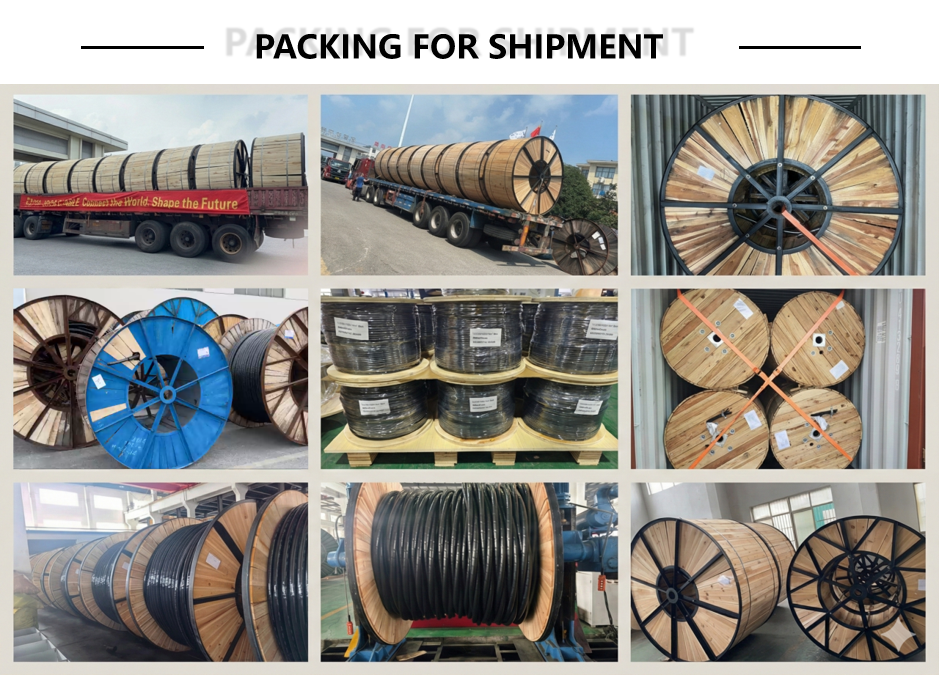
Packing For Shipment
To meet various transportation needs, there are many methods of packaging that can be used.
Have more questions?
Q: Voltage Classification?
A: MV Class. Rated specifically for 11kV and 33kV networks.
Q: Phase Conductor Material?
A: H68 Aluminum. (Circular Compacted Stranded). Compliance: BS2627 Standard.
Q: Suspension Mechanism?
A: Galvanized Steel Messenger. Acts as the primary catenary wire to carry static cable load and tension.
Q: Metallic Screen Options?
A: Configurable. Available with Copper Wire or Copper Tape screens based on fault current specifications. (Default: Optional).
Q: Sheath Composition?
A: HDPE. Selected for high mechanical impact strength and environmental weathering immunity.
Q: Bundle Geometry?
A: Triplex Arrangement. Three screened XLPE cores twisted around the steel messenger (Right-Hand Lay).
Q: Insulation System?
A: XLPE. Thermal Class: 90°C. Provides superior thermal overload retention compared to PVC/PE.