


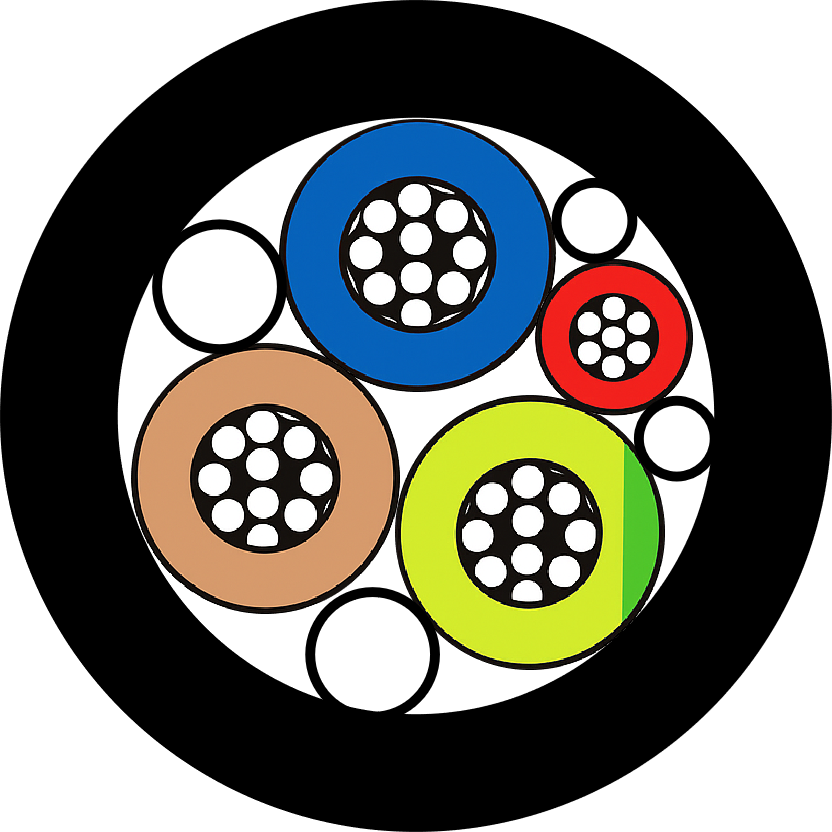





Mentioning electrical systems and connectivity, these two words–“wire” and “cable”— are synonymous. However, they have varied attributes and serve diverse purposes in electrical applications. Knowing how to differentiate between wire and cable is vital for a practitioner, for a person engaging in DIY work, and when selecting one for a specific material need. We shall unwrap the confusion that envelops these terms, dive into their salient differences, and guide you on their times of usage, wherein you will come to understand these terms better and earn the ability to make good choices for any of the following projects.
What is Wire?
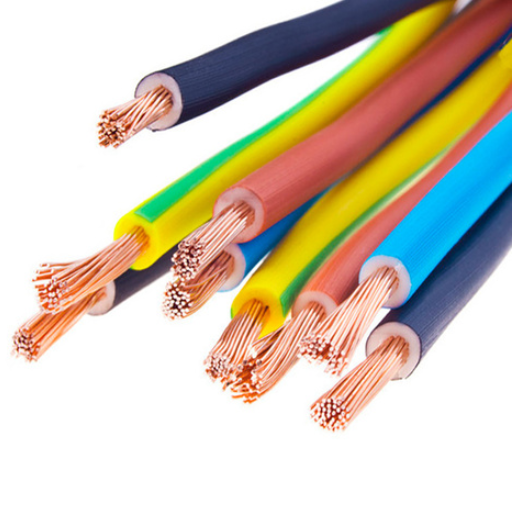
A wire is a thin, flexible strand of a conductive form of metal, such as copper or aluminum. It carries electricity from one point to another, with some form of insulation for safety and protection. The wire is a crucial component of an electrical system, as it connects devices and circuits to power sources.
Definition of Electrical Wire
An electrical wire is a conductor or a set of conductors that transmit electricity. Typically, wires are manufactured from highly conductive materials, such as copper or aluminum, as they are very efficient in conducting electric currents. Electrical cables are covered with insulation materials, such as PVC or rubber, that serve as protective layers to prevent accidental contact, minimize fire hazards, and facilitate safer installation.
There are various types of electrical wires, each suited to a specific application. While single-core wires are commonly used for household wiring, multi-core cables are better suited for more industrial settings. In the U.S., residential wiring commonly uses wire gauges anywhere from 14 AWG (American Wire Gauge) to 10 AWG, depending upon the load. Modern wires satisfy very stringent safety requirements and may include additional features such as flame retardant and UV protection for outdoor use.
To ensure energy efficiency, wires are being updated with the use of self-sustaining materials and smart cables capable of higher data transfer rates for connected devices. This is a reminder of how ever-changing and imperative electrical wires remain in getting our homes and industries operational.
Types of Electrical Wires
Understanding the different types of electrical wires helps one choose the correct materials for various applications. Here are the main types, along with their uses and specifications:
1. Non-Metallic Cable: NM cables, also known as Romex cables, are commonly used for interior home wiring in dry locations. These cables contain two or more insulated conductors wrapped together in a plastic sheath. They are standard for carrying household electricity and are marketed in different gauges, such as 14/2 or 12/2, which define the wire size and count.
2. THHN/THWN Wire: THHN (Thermoplastic High Heat-Resistant Nylon-coated) and THWN (Thermoplastic Heat and Water-resistant Nylon-coated) wires are the most sought-after wiring types in the industrial and commercial areas. These single-conductor wires are conversely versatile and are appreciated for being heat-resistant and water-resistant. For example, THWN-2 can resist higher temperatures, with a maximum operating temperature of 194°F (90°C) in wet and dry conditions.
3. UF (Underground Feeder) Cable: These cables are employed for outdoor, underground, and submersible works. They possess a tougher outer jacket than NM cables, thereby making them more durable and resistant to moisture, sunlight, and other environmental influences. They are primarily used as connecting cables for outdoor fixtures, such as garden lighting or water pumps.
4. Armored Cable Goodies: AC and armored cables feature a metallic sheath to protect the enclosed wires. These cables are helpful where wiring needs to be secure but accessible, such as in remodeled quarters. The armor serves as a grounding path, improving the safety of the electrical systems.
5. Coaxial Cable: These cables are often used to carry television and internet signals, with a central conductor, insulating layer, metallic shielding, and an outer jacket. These are designed to maintain signal integrity and minimize electromagnetic interference, which is needed for top-notch data transmission. Their impedance standards, such as 50 ohms or 75 ohms, define their use in various applications.
6. Low-Voltage Wires: A low-voltage wire application involves wiring for doorbells, landscape lighting, security systems, and telecommunications systems. The wires carry 50 volts or less and are thinner than regular electrical wiring. These wires have insulation to prevent short circuits but are flexible enough to allow for easy routing.
7. Service Entrance (SE) Cable: They are intended for connecting overhead or underground electrical service lines to structures. These cables are either covered with durable thermoplastic insulation or a weather-resistant jacket for extra protection. They are rated for heavy loads and come with different conductors, each geared for either residential or commercial use.
Each type of wiring is designed for a specific electrical purpose, thereby ensuring safety, reliability, and utility in its application. Proper handling of each wiring type during installation will provide the best performance and a longer lifespan of the electrical system.
Common Uses of Wires
Wires serve as the transmitters of electrical energy, signals, and data in a panoply of situations and applications, requiring efficacy and safety. Below follows a brief list of some common usages:
Residential Wiring: Wires are connected to outlets, lighting, switches, and appliances, all to supply power to a home. Common types include non-metallic (NM) cables and single-conductor wire, meant for residential indoor and outdoor work.
Commercial and Industrial Wiring: Heavy-duty wires, such as armored cables (MC cables) or industrial-grade wires, are used in offices, factories, and industrial facilities to manage high electrical loads and ensure compliance with safety standards.
Electronic Devices: Fine wires are used to assemble and connect components in electronic devices, such as circuit boards, smartphones, computers, and audio systems, for delivering power and data.
Data Transmission: Copper and fiber optic cables are the mediums of transmission for high-speed internet, telecommunications, and network data, supporting modern digital communication systems.
Automotive and Transportation: Automotive wires are used to power various systems, including lighting, engines, and other components, in vehicles, aircraft, and ships. Such cables typically feature specialized insulation for enhanced temperature resistance, durability, and other desirable properties.
Careful selection, depending on the wire type, gauge, and insulation, is crucial in every application to ensure optimal performance and safety over a prolonged period.
What is Cable?

A cable consists of a pair or several wires enclosed together, often covered by insulation or protective sheathing. It carries electrical power or signal transmission from one location to another. The wired construction is designed for versatility, with size and material selection varying depending on the application.
Definition of Cable
General cables are essential components of electrical and communication systems, serving as pathways for the transmission of electricity, data, or signals. Cables consist of one or more conductors; generally, copper and aluminum are favored for good conductivity. They are, however, insulated by relevant materials, such as PVC, rubber, and polyethylene, which help prevent electrical leakage and environmental degradation. The design varies depending on the type of cable considered: power, data, or control.
Increasingly, applications are showcasing a high demand for advanced cable designs, with fiber optic cables at the forefront, as they transmit data at speeds of 1 Tbps. This capacity makes them very suitable for higher-speed internet and telecommunications. Industry standards specify rating criteria for cables, including voltage, temperature, and environmental considerations, through tests to determine how well the product fits a particular environment. For instance, submarine cable designed for undersea telecommunication can bear 8,000 psi and stretch for thousands of miles.
In summary, the construction and specification of the cable are crucial for the reliable and safe transmission of energy or information across various industries, including construction, telecommunications, energy distribution, and automation.
Types of Electrical Cables
Electric cables differ according to their design, material, and potential application. Some common types include:
Coaxial Cables: A coaxial cable features a center conductor, surrounded by an insulating layer, a metal shield, and an outer sheath for protection. They are widely applied in telecommunications, where they are used to transmit television signals, internet data, and other signals, thereby reducing signal interference.
Twisted-Pair Cables: These wires consist of two insulated copper wires twisted together to minimize electromagnetic interference. Twisted pair cables, a type of networking cable commonly used in Ethernet cables for local area networks (LANs) and phone systems, are included in these cables.
Fiber Optic Cables: Fiber optic cables carry information as pulses of light through thin glass or plastic fibers. They are used for very high-speed and high-bandwidth applications that require internet services and telecommunication, providing better reliability, higher capacity, and significantly longer transmission distances than conventional metal cables.
Power Cables: Cook power cables are designed to carry electricity for a wide range of voltage applications, ranging from low-voltage house wiring to high-voltage transmission lines. They usually consist of a conductor, an insulating layer, and an outer jacket for protection.
Control Cables: These cables are used in automation systems to provide reliable signal transmission to control equipment. These cables are highly flexible and resistant to mechanical stress, making them suitable for applications in robotics and industrial machinery.
Each type of electrical cable is designed to conform to specific sets of parameters, ensuring durability, efficiency, and safety in its respective applications.
Common Uses of Cables
Cables have applications in interfacing numerous industries to power critical systems and facilitate smooth communication. Some of the standard applications of wires, followed by their importance and uses in daily life:
Electric Power Transmission: Power cables are used to transfer electricity over long distances, from power generation plants to residential areas, commercial buildings, and industrial establishments. High-voltage cables are directly involved in the bigger energy distribution networks, with materials like XLPE (cross-linked polyethylene) going to newer frontiers in improving safety and efficiency. For example, modern high-voltage cables can operate at up to 500 kV, ensuring a stable transmission infrastructure to meet the needs of both urban and rural areas.
Telecommunication and Data Transfer: The backbone of modern telecommunication has been fiber optic cables, which enable high-speed internet and connectivity worldwide. With minimal loss in transmission over long distances, fiber optic cables continue to play a central role in supporting streaming, online gaming, and cloud-based services. The global fiber optic cable market was valued at over $10 billion in 2022, indicating a growing demand in sectors such as IT, healthcare, and innovative urban projects.
Automotive and Transportation: Cables in the electric vehicle, railway, and aerospace trades are pretty specialized. For example, EV charging cables are designed to allow high electrical currents to flow while ensuring safety. By 2030, the global EV cable market is expected to grow at a CAGR of more than 25% due to the transition toward sustainable transportation.
Industrial Automation: Control and instrumentation cables are crucial for machinery to facilitate automated operation, ensuring accurate communication between sensors, controllers, and actuators. These cables are designed to endure deteriorative conditions such as abnormal temperatures and exposure to oil or chemicals, making them essential in industries related to manufacturing, oil and gas, and robotics.
Renewable Energy: Cables are used to harness renewable energy sources, including solar, wind, and hydropower. Solar cables resist UV radiation and harsh environmental conditions, connecting photovoltaic panels to inverters. Submarine cables, on the other hand, carry energy generated by offshore wind farms to onshore grids. Renewable energy is expected to contribute more than 50% of the global electricity supply by 2050; therefore, demand for sturdy, specialized cables is increasing.
This further underscores the indispensable role that cables play in modern infrastructure and technology. The improvement and development in cable technologies ensure they keep pace with the demands of efficiency in energy, connectivity, and sustainability.
Difference Between Wire and Cable
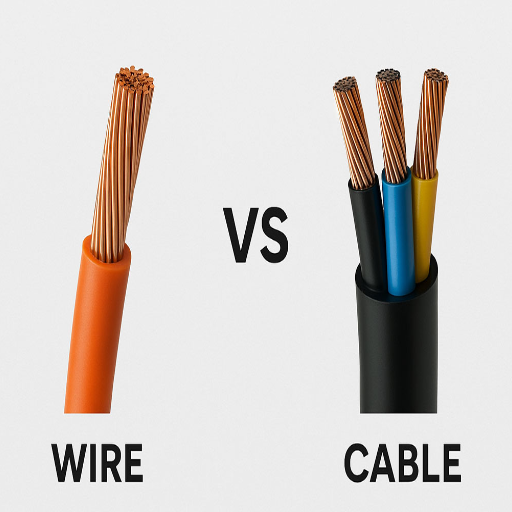
Wires and cables both have the function of transmitting electricity, but have delineating differences between them:
A wire is a single conductor, commonly copper or aluminum, which may or may not be insulated. It is generally used for simpler electrical applications such as house wiring or circuit connections.
Cables consist of two or more wires, insulated from one another, and bonded together, often covered with an outer sheath. They are used for more complex activities such as underground power transmission or telecommunications.
The difference comes down to one of basic structure: wires are single conductors, while cables are two or more conductors grouped.
Key Distinctions
Cables are insulated groups of wires used for complex tasks, while wires are single conductors, typically used in simpler applications.
|
Parameter |
Wire |
Cable |
|---|---|---|
|
Structure |
Single conductor |
Multiple grouped |
|
Insulation |
Minimal or none |
Fully insulated |
|
Applications |
Simple/electric |
Complex/power/data |
|
Flexibility |
Less flexible |
More flexible |
|
Durability |
Lower |
Higher |
|
Usage |
Household wiring |
Underground, telecom |
|
Sheath |
No outer sheath |
Protective sheath |
Wire vs Cable: Applications
Wires are used for simpler applications, such as household wiring, while cables are employed for more complex tasks, including telecommunications, power distribution, and underground applications.
|
Aspect |
Wire |
Cable |
|---|---|---|
|
Application |
Simple tasks |
Complex systems |
|
Insulation |
Minimal |
Full covering |
|
Flexibility |
Lower |
Higher |
|
Durability |
Standard |
Enhanced |
|
Safety |
Basic |
Protective |
|
Usage Area |
Indoors |
Underground |
When to Use Wire vs Cable
The requirements of your project will determine whether to use wire or cable. Wires are ideally suited for simple operations, such as internal house wiring, where flexibility and minimal insulation are required. They can also serve to connect devices or circuits across shorter distances where safety requirements are basic enough.
Cables are used in more complex systems where higher durability and protection are required. They are the preferred choice for underground installations, power distribution, and telecommunications, which require multiple insulated conductors. They are also preferred outdoors or in harsh conditions due to their coatings being more resistant to foul environmental factors and their security features.
Types of Electrical Wires and Cables
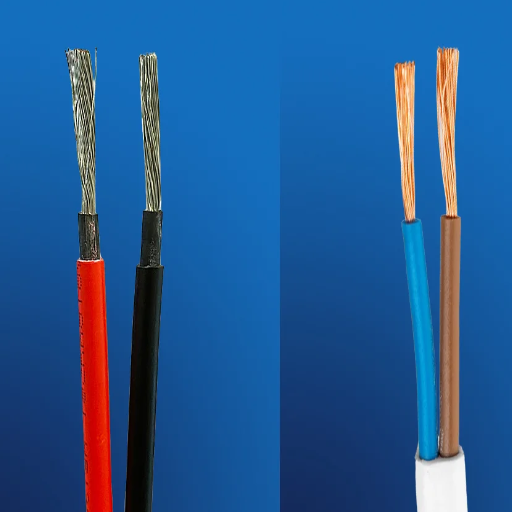
Single-Conductor Application Wires: These are the most commonly used wires for standard residential and commercial wiring. They can be solid or stranded, offering flexibility in design and any application.
Multi-Conductor Cables: These cables contain insulated conductors enclosed in a bundle and are often used in appliances that require multiple signals or power transmission.
Coaxial Cables: The primary function of coaxial cables is to transmit television and internet signals. The central conductor is surrounded by an insulating layer, a shielding layer, and an outer insulating layer, which together offer excellent signal protection.
Twisted Pair Cables: Primarily used in telecommunications and computer networking, these cables consist of wires twisted together in pairs to minimize electromagnetic interference.
Fiber Optic Cables: High-speed data transmission using light is the forte of fiber optic cables. They are best suited for long-distance and high-bandwidth communication systems.
Choosing a wire or cable depends on its properties, such as durability, flexibility, insulation, and its ability to work in a particular atmosphere. Knowing their properties provides insight into which option is best suited for a given task.
Overview of Wire Types
Wires and cables, in their various forms, serve multiple purposes depending on their unique features, making them indispensable in modern electrical and electronic systems. Below is a glance at the significant types:
Copper Wires: Copper wires are utilized for their electrical conductivity in various applications. The copper wire used in residential, commercial, and industrial wiring applications is resistant to corrosion and relatively easy to bend, making it suitable for applications that require flexibility and resilience.
Aluminum Wires: Used for power distribution purposes, these wires are lighter and less expensive than those made from copper. Aluminum wires cannot conduct electricity as well as copper wires, but designs that use aluminum alloys have improved their performance and reliability. If in doubt, always take precautions against oxidation.
Fiber-Optic Cables: These cables transmit data through light, thus offering the highest speed and bandwidth possible. Fiber optics is used in internet infrastructure, telecommunications, and networking systems, especially in long-distance and high-data-rate communication.
Coaxial Cables: These are used for cable television and internet services. They have an inner conductor surrounded by insulation, followed by a shield that minimizes interference from wiring during signal transmission.
Control Cables: Used in industrial automation applications, these cables carry signals to control machinery and equipment. The wires must be rugged and resistant to oils and chemicals, suitable for use in dynamic environments.
The selection of wires/cables depends on factors such as conductivity, environmental conditions, flexibility, and insulation. Having a good understanding of these factors will help create the best electrical system from both performance and safety standpoints.
Overview of Cable Types
Cables are essential elements in the world’s infrastructure, connecting various devices and systems across numerous industries. Below is a detailed overview of different types of wires, their applications, and relevant information.
1. Coaxial Cables: These cables are primarily used for transmitting TV signals, internet data, and telephonic signals. They are made of the conductor, surrounded by insulation, which is layered by metallic shielding, and then further enclosed by an outer jacket. Coaxial cables effectively utilize high bandwidth and counter interference, making them best suited for applications in very high-frequency ranges. A typical example is the RG-6 cable, which supports frequencies of up to 3 GHz, allowing for high-speed and reliable data transmission.
2. Fiber Optic Cables: Fiber optic cables transmit data through light, thus providing better speed and long-distance communication as compared to copper-based wires. Such cables comprise glass fibers and can reach data speeds of 100 Gbps or above. Some high-bandwidth, low-latency, and EMI-immune industries, such as Telecommunications, Medical Imaging, and Aerospace, make heavy use of fiber optic cable.
3. Ethernet Cables: Cables like Cat5, Cat6, and Cat7 are widely used for various networking purposes. They serve as data transmitters between routers, switches, and other devices, forming a local area network (LAN). The Cat6 cable, for instance, supports a transmission speed of up to 10 Gbps for a distance of 55 meters, hence the choice of such wires in high-performance enterprise setups.
4. Power Cables: The categories of cables that draw power from the source and transmit it to various industrial equipment, buildings, apparatus, and other devices are called power cables. The normal ones are low-voltage cables and mid-voltage cables, while the others are high-voltage cables, designed to serve high voltages. The high-voltage cables carry up to approximately 500 kV in large-scale infrastructure projects, such as power plants and substations.
5. USB Cables: Universal Serial Bus (USB) cables are used in consumer electronics, often for data transfer and power delivery. The newest USB-C can transfer at a 40 Gbps speed (Thunderbolt 4) and deliver 240 watts of power, enabling the charging of laptops, tablets, and other power-demanding gadgets.
6. Armored Cables: Armored cables offer an additional level of protection in industrial applications with a tough environmental ambiance. These cables are installed in most industrial settings, underground installations, and outdoor applications. They afford the most excellent mechanical protection from hazards from moisture, abrasive substances, and rodents.
7. Submarine Cables: Submarine cables represent approximately 99% of international data transmission, connecting the oceans beneath the continents. These cables can be laid for thousands of kilometers and are made to face extremely high underwater pressures. For example, present-day submarine cables transport data rates of terabits per second, thereby securing a robust global communication network.
Each of these types caters to particular technical needs and environments. Developments in cable technology continue to improve energy efficiency, data security, and meet global connectivity demands.
Choosing the Right Type for Your Needs
Selecting the correct cable type depends on factors such as application, performance requirements, and environmental conditions. For instance, fiber optic cables are best suited for high-speed data transmission over long distances, with some of the more modern fibers being capable of transmitting up to 400 Gbps per channel simultaneously. Due to the high-bandwidth capacity and low-latency features of fiber, typical fiber optic cables are installed in telecommunications, data centers, and broadband internet services.
Coaxial cables, on the other hand, generally perform well over short distances and achieve their maximum speed of approximately 10 Gbps in their highest implementation with the latest DOCSIS standards. Ethernet cables, such as Cat 6A or Cat 8, are a better choice for office networks or home setups, providing speeds ranging from approximately 10 Gbps to 40 Gbps, depending on the specific category and cable length.
For use underwater and in other subsea applications, submarine cables equipped with extra armor layers will remain operational in extremely harsh underwater environments to depths exceeding 8,000 meters, capable of handling terabit volumes to ensure continental and global connectivity.
They should be well considered as future-proof cables, given the massive demand for high-speed and reliable networks. A prime example is the optical ground wire (OPGW), which, along with new hybrid cables, combines features for both data transmission and electrical power transmission, making it very versatile for power utilities and communication providers.
Every cable type comes with a distinct benefit for a specific demand; hence, it is crucial to consider the speed of data transmission, the distance involved, environmental durability, and the associated costs.
Wire and Cable Confusions
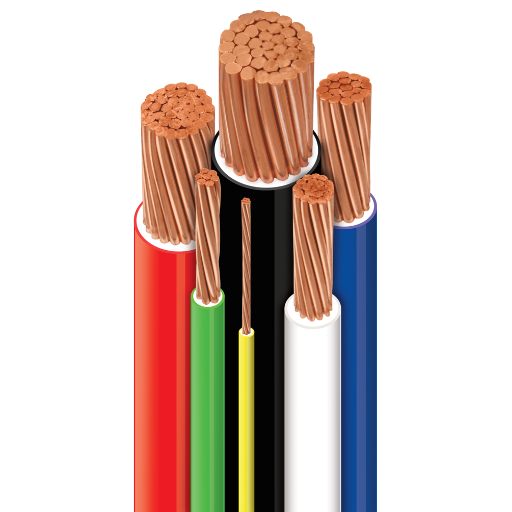
When addressing wire and cable confusion, consider these straightforward responses to common questions:
Data Speed vs. Transmission Distance: High-speed cables, such as fiber optics, are ideal for long distances, offering minimal signal deterioration and high-speed data transmission. For shorter distances, copper cables may suffice, but they are not considered suitable for high-speed and efficient applications.
Environmental Durability: The cable should be evaluated in terms of the specific exposure conditions. For example, OPGW cables are ideal for outdoor installations due to their resilience against weather, whereas indoor conditions may permit the use of less resistant wires.
Cost vs. Performance: Cost and performance must be balanced. Hybrid cables, which carry both power and data, can reduce installation costs but generally have higher upfront prices.
By knowing these facts, it is easier to select cable solutions suited to the particular needs.
Understanding Wires Made for Specific Uses
Understanding wires for a particular use always involves identifying the scenario- and environment-dependent requirements. I would choose weather-resistant ones for outdoor installations, while indoors, simpler cables usually suffice due to cost considerations. Sometimes I weigh cost and performance, wondering if hybrid cables earn their higher upfront costs by being less expensive to maintain. By considering these criteria in this order, I have somehow determined the correct cable.
Myths about Electrical Wires and Cables
Myth: Thicker wires are always better for any application.
Fact: Although a thicker wire can carry more current, it is not necessarily the ideal choice for every application. The wire gauge to be used depends solely upon the loading of the electrical appliances and the distance involved. The use of oversized wires only adds unnecessarily to the cost, with no added advantage.
Myth: Electrical cables can never overheat so long as they are adequately insulated.
Fact: Overheating, which causes the current to flow excessively, cannot be prevented by insulation or due to an installation fault. This type of overheating can occur when a wire is forced to carry a current load beyond its maximum rating, potentially leading to a fire hazard.
Myth: Aluminum wires are unsuitable and are inferior to copper ones.
Fact: While the conductivities of aluminum are lower than those of copper, it is lighter, less expensive, and perfect for many particular applications. Aluminum wiring must be correctly installed and sized to assure safety and performance.
Myth: Waterproofing is the nature of all electrical wires.
Fact: Not all wires or cables are made to sustain exposure to water or moisture. For outdoor or underwater installations, use specialized weatherproof or waterproof cables designed to protect the equipment from damage and ensure safety.
Myth: Electrical cables last forever once installed.
Fact: All wear has its finite lifespan, which is estimated to be shortened due to wear and tear, heat, UV rays, mechanical stress, and other factors. Cables must be inspected regularly and maintained to prevent any hazards.
By dispelling these popular myths, informed decisions can be made, thereby enhancing the safety and efficiency of an electrical system.
Reference Sources
1. Effect of Coating on Stress Corrosion Performance of Bridge Cable Steel Wire
2. Research on Interactive Routing of Cable in a Virtual Environment
3. The Application of Carbon Fibre Reinforced Polymer (CFRP) Cables in Civil Engineering Structures
Frequently Asked Questions (FAQs)
What’s the difference between wire and cable?
The difference between wire and cable lies primarily in their construction and purpose. A wire is typically a single conductor made of copper or aluminum, while a cable consists of multiple wires bundled together, often insulated and designed for specific applications. Cables can transmit power and data more efficiently due to their construction.
What types of electrical wires are commonly used?
Common types of electrical wires include solid wire and stranded wire. Solid wire consists of a single strand, while stranded wire is made up of multiple strands braided together. Each type has its advantages, with solid wire being more suitable for stationary applications and stranded wire offering flexibility for moving connections.
What are the different cable types?
Different types of cables include coaxial cables, fiber-optic cables, and twisted-pair cables. Coaxial cables are often used for cable television and internet connections, while fiber optic cables, which can be made from glass or plastic, transmit data over long distances with minimal loss. Twisted-pair cables are commonly used in networking applications.
What wires are used for electrical installations?
In electrical installations, insulated wires such as THHN or NM-B cable are commonly used. These wires are designed to transmit power safely and efficiently, with insulation that protects against electrical shocks and short circuits. The choice of wire gauge depends on the current load and distance.
Are wires and cables often used interchangeably?
Yes, the terms “wire” and “cable” are often used interchangeably in casual conversation. However, it is essential to understand the technical differences, as wires refer to individual conductors, while cables are composed of multiple wires and often have insulation and protective sheathing.
What is a neutral wire, and how is it used?
A neutral wire is an electrical conductor that carries current away from the load back to the power source. In a typical electrical system, the neutral wire is insulated and used in conjunction with hot cables to complete the circuit, ensuring the safe operation of electrical devices.
What is the significance of gauge wire?
Gauge wire refers to the thickness of the wire, which is crucial for determining its current-carrying capacity. A lower gauge number indicates a thicker wire, which can handle more current, while a higher gauge number indicates a thinner wire, suitable for lower power applications.
How are wires made, and what materials are used?
Wires are typically made from conductive materials, such as copper or aluminum. The manufacturing process involves drawing the metal through a series of dies to reduce its diameter, followed by insulation to protect against electrical shorts and environmental factors. Some wires are also designed with specific coatings to enhance conductivity.