






Understanding Ethernet Cable Categories
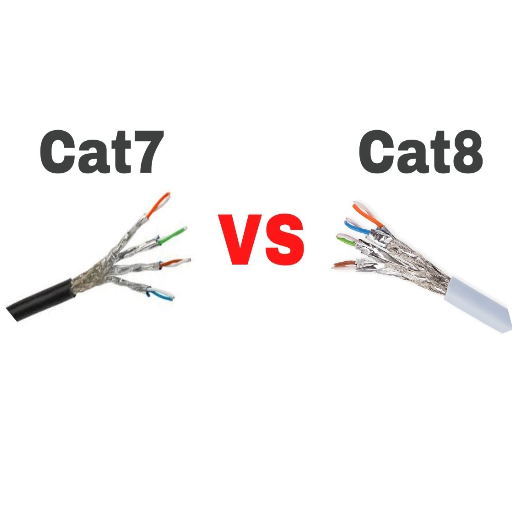
Ethernet cable categories specify the performance standards and capabilities of the cables in terms of speed, frequency, and shielding. Cat 7 supports a speed of 10 Gigabits and a maximum frequency of 600 MHz, which is sufficient for a high-speed home network with some professional applications. Cat 8, on the other hand, achieves speeds of 40 Gigabits and a frequency of 2000 MHz, making it suitable for data centers and very demanding enterprise and industrial applications. Both cables are shielded to prevent interference; however, Cat 8 classifications serve short-distance, high-performance applications much better due to their highest-performance ratings. For typical home users, Cat 7 is sufficient, and Cat 8 is suitable for specialized, high-speed operations.
What is Cat 7 Cable?
Cat 7 or Category 7 cable represents a class of high-performance Ethernet cabling capable of supporting transmission frequencies up to 600 MHz. It can transfer data at speeds of 10 Gbps for distances of up to 100 meters, providing utmost reliability and stability to any high-speed home or office network.
A notable feature of these cables is that they are shielded both at the level of individual twisted pairs and as a whole, thereby significantly reducing EMI and Crosstalk. Cat 7, therefore, finds use especially in high-noise environments or in instances where many cables are running alongside one another.
Key Features:
- Backward compatibility with Cat 5e and Cat 6
- GG45 or TERA connectors for enhanced performance
- Superior shielding for EMI protection
- Ideal for smart TVs, gaming consoles, and servers
What is Cat 8 Cable?
A Cat 8 cable is the newest generation of Ethernet cable that meets the high requirements of present-day high-speed networks. Thus, it achieves a significant improvement in performance compared to others, with data transfer rates reaching 40 Gbps at a distance of 30 meters. Hence, it presents an optimal choice for any data center, server room, or environment that requires high bandwidth.
Cat 8 cables feature S/FTP shielding to minimize crosstalk and EMI, ensuring stable connections even in high-noise environments. The cables carry a max bandwidth of 2,000 MHz, which is much greater than the rather modest 600 MHz of Cat 7. These features thus make Cat 8 perfect for the next-generation applications of the 25GBASE-T and 40GBASE-T networks.
Key Features:
- Backwards compatibility with previous Ethernet standards
- Gold-plated RJ45 connectors for enhanced conductivity
- Superior S/FTP shielding
- Ideal for data centers and server applications
Overview of Cable Categories
Ethernet cables are categorized based on performance standards, bandwidth, and maximum transmission speeds. Here is a brief accounting of the more commonly used categories:
| Category | Max Speed | Bandwidth | Max Distance | Primary Use |
|---|---|---|---|---|
| Cat 5e | 1 Gbps | 100 MHz | 100 meters | Home and office networks |
| Cat 6 | 10 Gbps (up to 55m) | 250 MHz | 100 meters | Faster networks with reduced interference |
| Cat 6a | 10 Gbps | 500 MHz | 100 meters | Industrial and data center applications |
| Cat 7 | 10 Gbps | 600 MHz | 100 meters | High-performance professional environments |
| Cat 8 | 40 Gbps | 2000 MHz | 30 meters | Data centers and enterprise environments |
Each category of cable is designed for specific applications, and Cat-8 represents the cutting-edge high-speed standard, while Cat-5e and Cat-6 are the most common choices for household and small businesses.
Speed and Bandwidth Comparisons
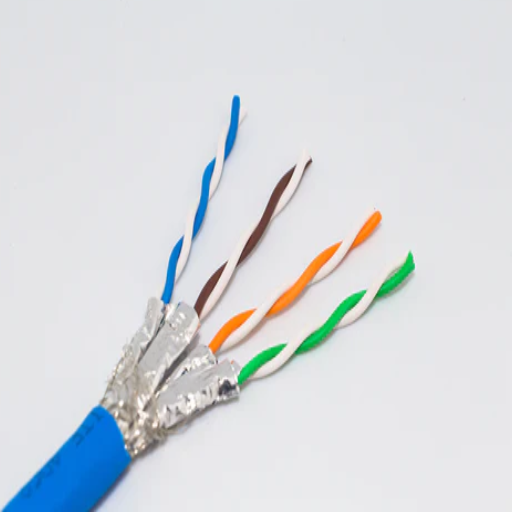
Data Transfer Rates of Cat 7 vs Cat 8
Cat 7 cables are designed to efficiently transfer data at 10 Gigabits per second, with a bandwidth capacity of 600 MHz. These cables are well-suited for applications that require high-speed data and bilateral communications over longer distances. Cat 7 cables sometimes put up a good show in home networks and small office environments where high-level performance is not a significant issue.
On the other hand, Cat 8 cables offer a significant leap in performance, capable of carrying data transfer rates of up to 40 Gbps, with a bandwidth of 2000 MHz. With this higher bandwidth, Cat 8 can handle very demanding tasks, including server communications at high speeds and intensive data transfers in data centers. With a maximum transmission distance of 30 meters, Cat 8 ensures lower latency and the highest performance over short ranges.
Bandwidth Capabilities of Cat 7 and Cat 8 Cables
Cat 7 cables provide bandwidths of 600 MHz and are suitable for almost every high-speed internet application, including the transfer of large data sets or streaming video. Any bandwidth that can facilitate the smooth application of these cables in a gigabit Ethernet network is a viable tradeoff for use in both commercial and residential purposes.
Hence, Cat 8 cables, with an estimated theoretical capacity bandwidth of up to 2000 MHz, greatly overshadow the Cat 7 cables. This giant leap has been built to cater to the demands of present-day data centers, high-performance computing environments, and many other advanced applications where ultrafast data transfer rates are an absolute necessity. These cables provide transfer speeds of up to 40 Gbps for distances of under 30 meters and thus complement the exemplary needs of enterprise networks handling large-scale data perfectly.
Real-World Performance Metrics
While Cat 7 and Cat 8 Ethernet cables differ in specifications, serving different networking environments, Cat 7 has a maximum bandwidth capacity of 600 MHz, allowing for stable and effective transmission rates of up to 10 Gbps across distances of 100 meters. It is suitable for home networking, small office networking, and data transmission that requires reliability over medium cable lengths.
Cat 8 transmissions, however, take the concept of speed further by accommodating bandwidths up to 2000 MHz to transfer data at 40 Gbps. This kind of high-performance connectivity needs to be exploited in a data center setup, created for enterprise-level networking or server rooms where clearly fast connectivity is required. On the downside, the maximum operating length in the optimum state is restricted to 30 meters. Hence, it is intended for niche applications, such as switch-to-switch or device-to-device high-speed interconnects.
With a bit more background, it is worth mentioning that lab testing and field measurements have been conducted to demonstrate that Cat 8 cables offer less interference and, therefore, provide better shielding against crosstalk and resultant signal degradation compared to Cat 7. Both cables are backward compatible, offering immense assistance in deployment on a networking system based on older Ethernet standards, with some degree of support for a few newer standards for improved performance.
Main Differences Between Cat 7 and Cat 8
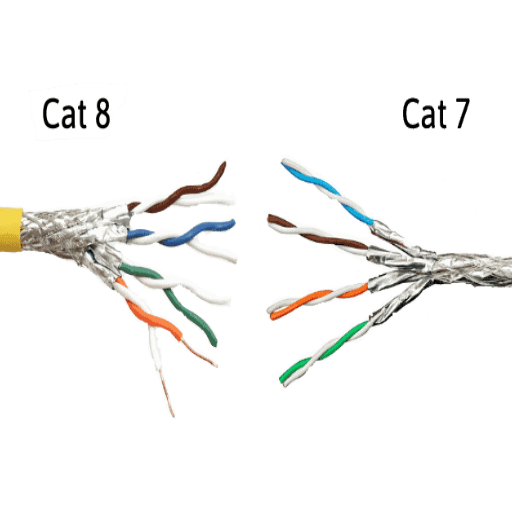
- 1Maximum Bandwidth: While Cat 7 can handle bandwidths up to 600 MHz, Cat 8 can offer bandwidths as high as 2000 MHz, making it compatible with high-speed applications.
- 2Data Transmission Speed: Cat 7 offers transmission speeds up to 10 Gbps, wherein Cat 8 transmits faster with a speed of up to 40 Gbps, albeit over shorter distances.
- 3Cable Length: Up to 100 meters. Cat 7 cables maintain their operating characteristics, whereas Cat 8 is tailored for distances shorter than 30 meters for full performance.
- 4Applications: Cat 8 is designed for data centers and high-performance networks with ultra-fast connection requirements, while Cat 7 is primarily intended for home networking and less demanding setups.
- 5Shielding and Crosstalk: While both cables have shielding to reduce crosstalk, Cat 8 has been enhanced to offer better shielding, which translates to signal integrity in an interference-prone environment.
- 6Future-Proof: With its maximum specification, Cat 8 can handle current networking demands and those of the near future, while Cat 7 may not be able to cater to the very high-speed requirements of emerging technologies.
Physical and Structural Differences
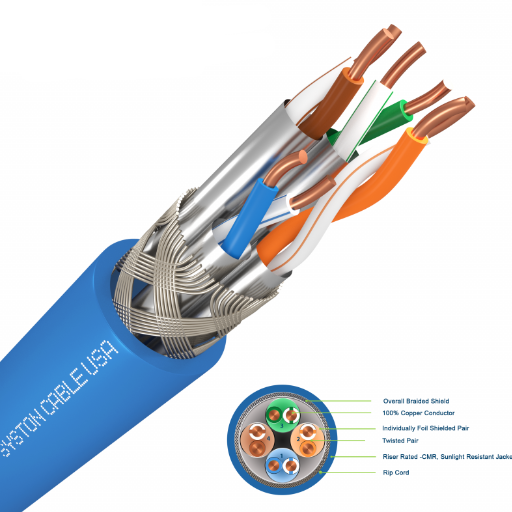
Cat 7 and Cat 8 Ethernet cables show notable differences in the physical composition and structural specifications. Cat 7 cables supposedly feature an S/FTP design, wherein each pair of wires in the cable is shielded, with an additional shield surrounding the entire cable. This helps mitigate external electromagnetic interference (EMI) and enhances data transmission stability. On the other hand, Cat 8 cables utilize a more advanced shielding mechanism, such as S/FTP or F/FTP, to further improve signal quality and reduce crosstalk in high-performance environments.
Physical Characteristics:
- Cable Diameter: Cat 8 cables are typically thicker than Cat 7 cables due to their enhanced shielding and materials
- Flexibility: Cat 8’s thick sheath results in slight reduction in flexibility but far better protection from external interferences
- Insulation: Cat 8 cables use high-density polyethylene (HDPE) for insulation, which reduces signal attenuation
- Heat Resistance: Cat 8 cables can withstand thermal constraints or excessive heat better than Cat 7
Performance Differences
Cat 8 Performance Advantages
- Ultra-fast data transfer speeds up to 40 Gbps
- Superior 2 GHz bandwidth capability
- Better configuration of shielding for reliability
- Lowest latency for real-time applications
- Enhanced noise reduction and EMI protection
Cat 8 Performance Limitations
- Limited to 30-meter distances for full performance
- Higher cost compared to Cat 7
- Requires compatible equipment for full utilization
- Overkill for basic home networking needs
- Less flexible due to thicker construction
When considering the data transfer speeds that Cat 8 and Cat 7 cables can achieve, one major difference stands out. The Cat 8 cables are designed to handle data transfer speeds of up to 40 Gbps at a 2 GHz bandwidth (2000 MHz), making them suited for ultra-fast connections in high-performance data centers, server applications, and other demanding environments. On the other hand, the Level 7 cable supports 10 Gbps speed and 600 MHz bandwidth, which is more than enough for almost all modern homes and general offices.
Cost Considerations
When considering the price of Cat 7 and Cat 8 cables, one must weigh the initial cost against long-term value, which is influenced by performance requirements. Cat 7 cables are generally less expensive, with an average price estimate of roughly $0.20-$0.50 per foot, and are considered the economically viable type of wire for home and small business settings where ultra-advanced data transfer speeds are not required. The price range for Cat 8 cables is considerably higher, from $1.00 to $2.00 per linear foot, depending on their speed capabilities and level of shielding.
In a high-end scenario, such as in data centers operating at speeds of 40 Gbps over very short distances, time, speed, and reliability provide the greatest dividend from an expensive installation of Cat 8 cables. However, for those environments that pose lesser demands, the minimal difference it adds to a system cannot justify the price difference. The cost of installation may also be high because Cat 8 cables are often stringent when it comes to connectors and hardware compatibility, potentially driving the overall costs higher. Considering these factors helps you ascertain which solution is best for your network and its costs.
Choosing the Right Ethernet Cable for Your Needs
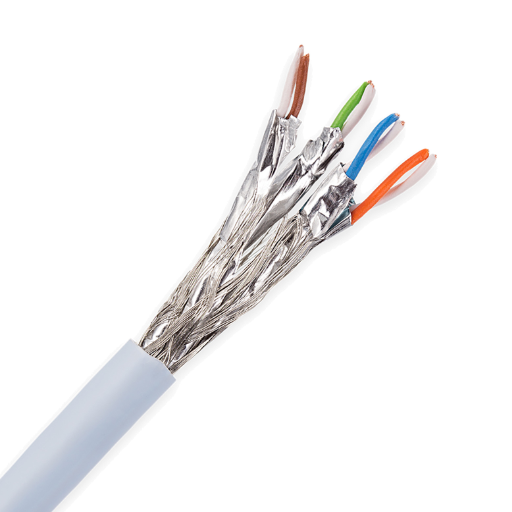
Depending on a network’s speed, distance, and budget, you select an Ethernet cable for your particular needs. For higher-grade homes or small office networks, Cat 5e or Cat 6 cables are excellent options. They provide a bandwidth of up to 1 Gbps and are compatible with almost all general network devices. If you require extra speed or want to be future-proof, Cat 6a and Cat 7 cables are more suitable, offering high performance and shielding. Considering the highly advanced and costly nature of Cat 8, the kind of high-speed applications that require this technology would be specialized, for instance, in data centers. Review your current setup and the use of the cable to determine which one offers a good compromise between price and performance.
When to Use Cat 7 Cable
Cat 7 cables are used wherever high-speed and high-bandwidth connectivity is required, especially in environments with significant interference. Since speeds can reach 10 Gbps at a 600 MHz bandwidth on Cat 7 cables, they make a perfect fit for specific professional environments, such as offices or home networks, where reliable and consistent connections are required for various activities, including video conferencing, 4K streaming, and large file transfers.
Ideal Applications:
- Smart home networks with multiple connected devices
- Professional video conferencing setups
- 4K streaming and multimedia applications
- Large file transfer operations
- Gaming environments requiring stable connections
- Commercial settings with interference concerns
When to Use Cat 8 Cable
Category 8 cable was designed for extremely high-speed data transfer and is ideal for specialized environments where the lowest latency and highest bandwidth can be guaranteed. It can support data transmission at speeds of up to 40 Gbps and frequencies up to 2 GHz, significantly faster than all earlier versions. Consequently, it becomes best suited for use in data centers, server farms, and enterprise-level networks where data needs to be transmitted at a great rate over short distances.
Optimal Use Cases:
- Data center switch-to-server connections
- Server-to-server high-speed links
- 4K/8K video editing workstations
- Cloud computing infrastructure
- Real-time data analytics environments
- High-frequency trading systems
- Enterprise backbone connections
Factors to Consider in Your Decision
When deciding whether to invest in Cat 8 cable for your networking needs, several important factors should be examined to determine if it is a suitable fit.
Speed and Bandwidth Needs
The Cat 8 cable stands first in performance, capable of transferring data at speeds of up to 40 Gbps with a bandwidth capacity of 2000 MHz. In other words, it is suitable for applications that require extremely high speed levels and bandwidth, such as in servers, media production, and enterprise environments. Analyze your current situation and future networking needs to determine whether this element is essential for your setup.
Cable Length and Installation Environment
As these cables are best employed for shorter cable runs of up to 30m for peak performance, they are suitable for situations where devices are closely situated, such as a server room. Being shielded means these cables have the advantage of rejecting interference, making them a good choice against loud noises with a significant amount of electromagnetic activity.
Compatibility with Existing Equipment
As a backward-compatible cable, it supports previous Ethernet standards, including Cat 6a and Cat 7. So for full utilization of its capabilities, your networking equipment (e.g., switches and network interface cards) should be Cat 8 standard-compliant. In some cases, it is necessary to invest in specialized equipment to achieve the maximum bandwidth that this cable can offer.
Cost of Implementation
While Cat 8 cables offer the best performance, they are priced accordingly and may not be suitable for everyone. Evaluate the performance points to determine whether they justify a significant investment. They are not necessary for cases in which the full bandwidth of a Cat 8 is not required. For smaller-scale operations or typical home networks, using a lower category cable would be even more cost-efficient.
Future-Proofing Your Network
With the escalating need for even faster and more reliable networks, Cat 8 stands as the interconnect of futuristic networking, with scalability built in to accommodate the unfolding trends in technology. For businesses planning to revamp their network infrastructure or those in the process of integrating cutting-edge applications, Cat 8 provides the complete solution to their concerns, enabling the realization of future innovations without prematurely wearing out the hardware.
Weighing all these factors will enable you to make an informed decision on whether a Cat 8 cable suits your specific networking environment. You will thus invest in your present needs, budget, and perhaps for future necessities to guarantee utmost efficiency in your working system.
Future Trends in Ethernet Technology
Advancements Shaping the Future
Higher Data Transmission Speeds: A prominent feature under constant development is the push for higher speeds of data transmission. With bandwidth-intensive needs such as 8K streaming, IoT devices, and cloud computing becoming popular, Ethernet standards are moving toward higher speeds of 400Gbps and beyond. This will keep enterprise and data center networks intact and resilient against rapid data growth.
Integration with IoT and Smart Technologies: Increasingly, Ethernet technologies are integrating with IoT ecosystems, enabling uninterrupted connectivity for smart devices across various domains. From smart homes to automated manufacturing systems, Ethernet networks provide the reliability and speed necessary to operate in real-time, marking an essential role in the interconnected world.
Energy Efficiency and Green Initiatives: Emerging Ethernet technologies aim to design systems that minimize power consumption without compromising performance. EEE standards introduce an enhancement that reduces operational costs while supporting global green initiatives, and this step is critical since networks are growing to meet demand.
AI and Automation in Practice: The two continue to develop Ethernet networks. An intelligent system remains capable of dynamically changing network configurations to optimize performance and identify potential issues, thereby improving efficiency and ultimately reducing downtime.
These trends show how Ethernet technology has evolved to meet the needs of modern and future application spheres, thereby providing a scalable, efficient, and forward-compatible networking infrastructure.
Advancements in Fiber Optic Cable
In recent years, significant advancements in fiber optic cable technology have occurred, significantly enhancing data transmission over long distances. One of the most significant advancements was the increase in bandwidth capacity. Modern fiber optic cables can perform data operations at rates of 400 Gbps and above, thanks to recent developments in DWDM technology. This allows multiple data streams to pass simultaneously on the same fiber, thereby improving efficiency and scalability.
Recent Fiber Optic Innovations:
- Bend-Insensitive Fibers: Improved durability and mechanical flexibility for easier installation in tight spaces
- Enhanced Materials: Advanced core designs that reduce signal attenuation and increase transmission reliability
- Extended Range: Modern fibers capable of transmitting data over 100 kilometers without signal amplification
- Hollow-Core Technology: Next generation fibers with air-filled cores for ultra-low latency applications
The next generation in fiber technologies, such as hollow-core, could have even lower latency as light can travel through an air-filled core instead of conventionally in glass. That is a primary factor in accelerating data transmission speed for applications requiring ultra-low latency, such as stock trading and real-time virtual reality systems.
These innovations aim to meet the growing demand for fast connectivity while promoting sustainability by reducing the energy required to transmit data, thereby maintaining fiber optic technology’s position at the forefront of global communication infrastructure.
The Evolution of Ethernet Standards
I believe the progression of Ethernet standards has been remarkable, adapting to ever-growing demands for faster and more efficient data communication. Ethernet has gradually evolved from the initial speed of 10 Mbps to gigabit and even multi-gigabit speeds so that modern networks of today could merge easily with it. Developments like these keep Ethernet flexible, allowing it to continue working for everything from a basic home LAN to a high-end data center. These constant standard upgrades ensure that Ethernet moves hand in hand with new and emerging technologies being introduced, and in turn, keep fueling global connectivity.
What Lies Ahead for Cat Cables?
The Future of cat cables lies in supporting the increasing demands for faster network rates and bandwidth as technology evolves. Being the latest standard, Cat 8 is designed for data-intensive environments, offering speeds of up to 40 Gbps over short distances. As industries continue to adopt more IoT devices, smart systems, and high-performance applications, Cat cables will adapt to continue providing reliable wired connections in hybrid and modern networks. Moreover, improvements in shielding and low crosstalk deadlines would keep the Cat cable interesting for sound data transmission between present and future needs.
Conclusion
The choice between Cat 7 and Cat 8 Ethernet cables ultimately depends on your specific networking requirements, budget constraints, and future planning considerations. Both cables represent significant advances in Ethernet technology, each serving distinct purposes in the modern networking landscape.
Cat 7 cables provide an excellent balance of performance and value, offering 10 Gbps speeds over 100-meter distances with robust shielding against interference. They are ideally suited for high-performance home networks, small to medium businesses, and professional environments where reliable, high-speed connectivity is essential without the extreme demands of enterprise-level applications.
Cat 8 cables represent the cutting edge of wired networking technology, delivering unprecedented 40 Gbps speeds over shorter 30-meter distances. They are specifically engineered for data centers, server rooms, and ultra-high-performance applications where maximum speed and minimal latency are critical requirements.
As networking technology continues to evolve with increasing demands from IoT devices, 8K streaming, cloud computing, and AI applications, both Cat 7 and Cat 8 cables will play important roles in supporting our interconnected future. The key is selecting the right cable that matches your current needs while providing adequate headroom for future growth, ensuring your investment delivers optimal performance and value over time.
Reference Sources
Progress on Analogue Front End for 2PAD
Simple Attenuation Models of Metallic Cables Suitable for G.fast Frequencies
Frequently Asked Questions (FAQs)
What are the main differences between Cat 7 and Cat 8 cables?
However, the main differences lie in speed and frequency capabilities: Cat 7 supports up to 10 Gbps of speed at a frequency of 600 MHz, while Cat 8 surpasses it by supporting speeds of 25-40 Gbps and a frequency of 2000 MHz. This makes a Cat 8 cable suitable for the best speed demands.
Talking about the construction of cables and their effect on Cat 7 and Cat 8 performances?
The cable construction is paramount in the performance of Cat 7 and Cat 8 cables. The better shielding present in Cat 8 cables, such as twisted pair shielding, reduces external interference and supports longer cable runs without attenuation. This is a crucial consideration when selecting between Cat 7 and Cat 8 for high-performance networking.
Are Cat 8 cables backward compatible with older cable types?
Yes, Cat 8 cables are backward-compatible for Ethernet standards, including Cat 7 and Cat 6. In layman’s terms, if you choose to install Cat 8 cable in a building with an existing older Ethernet network, there will be no loss of performance. However, the network’s overall performance will be limited by the capabilities of whatever older cable it is set up with.
What speeds and bandwidths do I get with Cat 7 vs. Cat 8 cables?
In terms of speed and bandwidth, Cat 7 cables are rated for 10 Gbps, while Cat 8 can go anywhere between 25-40 Gbps. This much difference in numbers puts Cat 8 into stern competition when it comes to high-speed data transfer, particularly for data centers and enterprise networks.
Is Cat 7 suitable for longer cable runs?
Generally, Cat 7 cables perform adequately for longer cable runs compared to previous cable categories, although their performance may be degraded over longer cable runs. For runs longer than 100 m, the Cat 8 cable is advisable, as it can perform faster and even longer than that.
What are some advantages of using Cat 8 Ethernet cables?
A Cat 8 cable has many advantages, including elevated data transfer speeds, superior shielding, and performance comparable to the best over longer cable lengths. They are therefore well-suited to high-speed applications such as data centers and server rooms, where performance and reliability are paramount.
And what about price? How much more does a Cat 8 cable cost compared to a Cat 7?
Cat 8 cables have high prices compared to Cat 7 cables just because of their newer technology and better performance. Cat 7 cables are good enough for many home and office networks. However, for those applications that require higher bandwidth and speed, it makes sense to invest in Cat 8.
Which Ethernet cable would best serve my network?
It will depend entirely on your needs for which Ethernet cable fits your network. You want to use high-speed data transfer if the network is very modern, so you go with 8. For average home setups, Cat 7 may suffice. When deciding between Cat 7 and Cat 8, always consider your speed, bandwidth, and distance requirements.