







Energy needs for household appliances need to be understood to bring about efficient regulation in terms of electricity consumption and to ensure the safe implementation of electrical systems in the home. Another appliance that raises curiosity is the washing machine-whether it consumes power and how many amps it draws during operation. Knowing washer amperage is an essential factor you consider as you set up a new laundry room, compute your overall energy consumption, or just out of curiosity about how much it affects your utility bills. This article will explore almost everything about washing-machine amperes-from what determines their energy consumption to ways of making sure you get the best efficiency. Stay tuned to unravel the details and impart suitable options for your household.
Introduction to Washing Machine Amperes
Energy needs for household appliances need to be understood to bring about efficient regulation in terms of electricity consumption and to ensure the safe implementation of electrical systems in the home. Another appliance that raises curiosity is the washing machine-whether it consumes power and how many amps it draws during operation. Knowing washer amperage is an essential factor you consider as you set up a new laundry room, compute your overall energy consumption, or just out of curiosity about how much it affects your utility bills. This article will explore almost everything about washing-machine amperes-from what determines their energy consumption to ways of making sure you get the best efficiency. Stay tuned to unravel the details and impart suitable options for your household.
The amperage of washing machines is linked with the amount of current a machine uses while in operation. Residential machines generally draw anywhere between 10 and 15 amps, depending on the model, the size, and the features of the machine. The efficient ones will draw a little less current; the old and big ones will draw a little more. The amperage rating tells us how much load an electrical system in your home must handle so that neither system overloads. Always check the specifications provided by the manufacturer or on the washer’s label to obtain an exact amperage reading.
What are Amperes?
In physics and engineering scenarios, the ampere is considered to be the basic unit of electric current flux. The name is derived from the French physicist and mathematician André-Marie Ampère, who substantially contributed to the field of electrodynamics. Hence, an ampere characterizes the movement of electric charge; in this instance, 1 ampere being the flow of 1 coulomb of charge across a conductor in 1 second.
Amperes serve as the measure of current in an electrical system. With this, amperage affects the functionality and power consumption of devices. For example, household appliances are all rated for a certain number of amperes to allow their safe and efficient operation. A small appliance, such as a charger for a mobile phone, will usually draw less than 1 amp, and refrigerators will then be rated anywhere between 3 and 5 amps. Depending on the size and capacity, heavy tools, for instance, air conditioners or electric water heaters, will be rated anywhere between 15 to 30 amps or even more.
By understanding the ampere rating, one knows how to select the circuit breakers, fuses, or wiring to ensure the safe operation of the electrical system, without any overloading. Residential electrical circuits, for instance, are usually rated for 15 or 20 amps. If this limit is exceeded, then there is the possibility of the Circuit overheating or tripping, which emphasizes why it is important to match appliances to the circuits they are rated for.
Importance of Knowing Washer Amps
Understanding the ampere requirements of a washer is important for the effective and safe operation of the appliance within your home electrical system. A good average residential range is from 10 to 15 amps, although varying models and additional applications may draw more. Washers that are high-efficiency or commercial tend to operate on higher amperage draws, particularly during cycles when heavy motor application or water heating is involved.
Knowing the exact number of amps your washer requires is essential to keep from overloading the circuit on which it is placed. If the washer is put on a circuit that cannot hold its rated power draw, it may cause circuit breakers to trip or, worse, cause fires. Proper practice suggests isolating 20-amp circuits for washers as per NEC regulations to prevent nominal interference from other household appliances.
Also, modern washers come with features such as steam cleaning or greater drum capacities that may draw more current. Reading pertinent information about amp use and electrical setup in the washer manual or on its energy label can help. Proper planning and knowledge guarantee maximum performance while ensuring the electrical safety of your home.
How Amperes Relate to Wattage
Amperes—or amps—and watts are very much the backbone of understanding electrical systems and energy consumption. Multiply the volts by the amperes to get watts:
This formula elucidates how it is watts that represent the total power being consumed by a device or appliance, whilst amperes quantify the current flowing through the circuit. For example, a household appliance that operates at 120 volts and draws 10 amps of electrical current will be consuming:
In actuality, the basis of this concept aids homeowners or electricians in determining whether the wattage consumed by an appliance exceeds, under, or equals the threshold of a circuit so it can safely be used. For instance, US residential circuits are usually rated to 15 or 20 amps. A space heater rated at 1,500 watts running on a 120-volt circuit will draw around 12.5 amps, leaving barely any room for other devices.
By contrast, higher-voltage appliances, like electric dryers or ovens functioning at 240 volts, will usually require fewer amps to achieve the same wattage. Say a 2,400-watt appliance, operating at 240 volts, will be pulling 10 amps, whereas under 120 volts operation, 20 amps are required.
Understanding this relationship is essential when going to any appliance or electrical upgrades. Being aware of wattage and amp needs will secure the safety of the circuit and efficiency of energy in houses and work environments.
Determining How Many Amps a Washer Uses
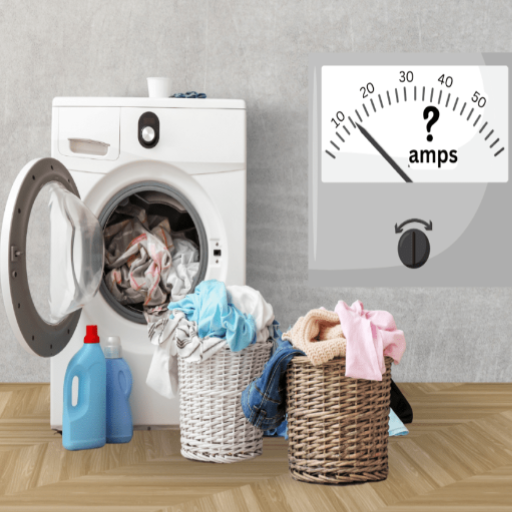
Amperage draws of a washer depend on its wattage and voltage. Most washers in the US operate at 120 volts and typically draw current between 5 A and 15 A. To find out the exact amperage, look for an amperage label, ratings, or user manual from which you can note the washer’s wattage and simply divide it by 120, since the voltage is standard. For example, an appliance with 1,200 watts will consume 10 amps (1,200 ÷ 120 = 10). Always double-check electrical specs for compatibility with your house circuits.
Standard Amps for Common Washers
Depending on their size and features, a standard US washer is rated for 10 to 15 amps. High-efficiency or new-age washers usually take closer to 15 amps, while compact or older-type washers might consume about 10 amps. Unlike the label attached on the washer, one has to consult the manual for exact specifications. That would tell you if it fits your home’s circuit or if there would be any issues while an appliance or two shares the same line.
Factors Affecting Washing Machine Ampere Usage
Ampere usage in washing machines depends upon a variety of factors:
- Machine Size and Capacity: Bigger washing machines or machines with larger drum capacities tend to consume more power because more power is required to operate heavy loads.
- Efficiency Rating: High-efficiency washing machines are built to conserve energy. So, depending on their technology, they may require either a greater or lesser number of amperes. Newer units in general require 15 amps each.
- Features and Functionality: More power-consuming features, such as a digital display, a high-speed spin cycle, or steam cleaning, may increase amp requirements.
- Age of the Appliance: Older models tend to be inefficient and, therefore, require less amperage. The usual numbers to be expected in this regard are around 10 amps.
- Cycle Type and Load Size: Cycle settings such as washes using the hot water use more amp power than the cold water washes. Larger loads also demand more power from the motor, thus affecting amp usage.
Understanding these things will help you better utilize the energy so that the washing machine can be put within your home’s wired electrical limit. Always refer to the user’s manual for details specific to your machine.
How Many Amps Does a Washer Use on Different Settings?
The number of amps a washing machine draws depends on the settings and added features. A look into amp use for the various common settings is listed:
| Washing Setting | Amperage Range | Description |
|---|---|---|
| Normal Wash Cycle (Cold Water) | 5-8 amps | Most contemporary washers draw between 5 and 8 amps on a normal wash cycle with cold water. Less power is consumed in this setting since no heating of the water is required. |
| Hot Water Wash Cycle | 10-15 amps | Connect the heater to do the heating, and then the amps soar through the use of hot water. On average, washers use around 10 to 15 amps on this setting, depending on the model and water heating activity. |
| High-Spin/Extra Rinse Mode | 10-12 amps | High-spin cycles push the motor for water extraction from the clothes and raise the consumption from 10 to 12 amps for a while. Extra rinse modes may merely perpetuate a longer period of operational time, thus affecting the amp consumption. |
| Eco-Friendly or Energy-Saver Settings | 4-6 amps | New washers have energy-saving settings that usually consume between 4 to 6 amps. These cycles are long but are designed to consume comparatively low energy overall. |
| Heavy-Duty or Large Load Settings | 12-15 amps | Larger loads or heavy-duty modes of operation used by washing machines are on another curve of consumption, with amps ranging anywhere from 12 to 15, depending on the stress put on the motor and water pump. |
Older washing machine models, styles with higher wattage motors, would consume more amperes than an energy-efficient modern-day drying machine. The precise amp measurement can be looked for against the machine’s user manual or its specification label. Also, under any circumstance, using energy-saving settings as much as possible will lessen amp consumption and energy costs in the long run.
Understanding Washing Machine Use and Efficiency
- Use Energy-Efficient Machines: Modern washing machines with energy-efficient ratings consume less power and water, thus making them cost-effective over time. Go ahead and check out those that carry the ENERGY STAR certification for the greatest abilities.
- Wash Full Loads: Using your washer for full loads reduces its frequency of use, hence saving energy and water.
- Select Cold Wash Settings: Doing laundry in cold water juxtaposes very far in significant energy savings since most energy goes into heating water during a cycle.
- Perform Routine Maintenance: Clean out that filter, fix those leaks, and free up the drum from anything restricting its spin.
- Use HE Detergents: Being detergents designed for modern washers, these use less water to rinse cleaners off, thus improving cleaning performance while saving water.
By following these steps, you can enhance your machine’s performance while conserving energy and water.
Energy Efficiency Ratings of Washers
Energy ratings can be at least a layman’s way to describe washer models that consume less energy and thus have a cheaper utility bill. Nowadays, washers are mostly given an Energy Star Certification, meaning they meet or exceed energy conservation standards set by an agency. Energy Star-certified machines, for instance, consume nearly 25% less energy and 33% less water than their conventional counterparts.
Another important rating is the Integrated Modified Energy Factor or IMEF, which scores a washer’s total laundry cycle energy consumption – including washing, spinning, and the machine in standby mode. The higher the number, the better the efficiency. Good ones boast about an IMEF rating equal to or greater than two-point-seven-six.
Water Factor (WF) is another parameter that determines the amount of water a washing machine uses per cubic foot of capacity. Washing machines with low WF ratings are classified as more efficient, whereas most of the high-efficiency front-loaders average somewhere between 3.0 and 4.0.
One can save their hard-earned money in the very long run by selecting products with high ratings of IMEF, low WF score, and Energy Star certified for the good of Mother Earth. Any other features, such as load-sensing and eco modes, further help in utilizing energy and water effectively so that every operation yields maximum efficiency.
Comparing Amps: Traditional vs. Modern Washers
| Washer Type | Amperage Range | Energy Features | Efficiency |
|---|---|---|---|
| Traditional Washers | 10-20 amps | Basic features, lacking energy-saving technology | Higher energy consumption |
| Modern Washers | 5-15 amps | Inverter motors, eco-modes, load sensing | 25% less energy than traditional models |
When looking at energy consumption, amperage use becomes an essential consideration between conventional and modern washers. Conventional washers usually draw from 10 to 20 amps, according to size and motor capacity. Lacking most energy-saving features, these machines consume quite a bit of electricity on every cycle.
Modern washers, however, are designed with energy efficiency in view. Most of the present models draw less power, usually from 5-15 amps. Energy-efficient front-loading models are designed for minimal water and electrical consumption. An example of some energy-saving features is inverter motors that can alter their power based on load size and better insulation to reduce energy consumption during operation. For instance, top modern washers with Energy Star qualification use 25% less energy than their traditional counterparts.
Moreover, when it comes to modern advanced washer settings, the quick-setting and eco-mode wash settings are settings that further reduce amperage consumption, in exchange for effective cleaning. These very efficient models, however, go on to save much on utility bills and respect sustainable energy preparations.
Calculating Electricity Needs for Washers
The power expected for washers is calculated with the following formula:
- Find the wattage of your washer. Usually, it is labeled somewhere on the exterior of the machine or found in the user manual.
- Estimate the number of hours the washer is used. It could be per day or per month, for instance.
- Calculate electric usage in kilowatt-hours (kWh) by means of the above formula.
Thus, in one cycle of operation, a list of one hour duration, a washer rated 500 watts would draw 0.5 kWh of electricity (500/1000). The total times of operation, hence, will be multiplied by the electricity units in estimating monthly or yearly consumption.
How to Calculate the Amps for Your Washer
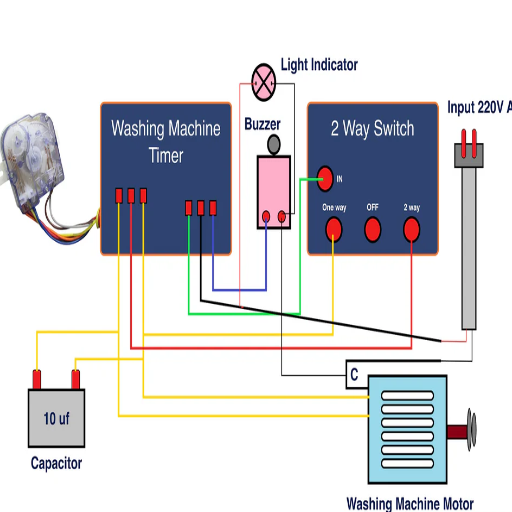
This is how to find the amps for your washer:
- Get the wattage for your washer – This is usually found on a label on the washer or in the user manual. If it’s given in kilowatts (kW), convert to watts by multiplying by 1000.
- Voltage must be known – Washers usually run on either 120V or 240V, depending on the model and branch. It should also be given on the label or the manual.
- Apply formula – Amps (A) = Watts (W) ÷ Voltage (V). In this way, amperage is calculated by dividing the wattage by the voltage.
Understanding 20-Amp Circuits and Their Importance
Most of the time, 20-ampere circuits are used for appliances or devices that require more power, both in residential and commercial sectors. The name of the circuit means it is capable of carrying safely 20 amps of current load, so without much performance or risk of melting, it can be there! These circuits are wired with 12-gauge copper wire, which is required since they need to deliver a greater current compared to 15-amp circuits made of thinner 14-gauge wire.
A 20-amp circuit is usually required for the more current-hungry appliances, such as refrigerators, microwaves, and power tools. Such circuits in kitchens, garages, or workshops are necessary just to avoid any nuisance tripped breakers and other kinds of electrical hazards. To recognize an outlet on a 20-amp circuit, one slot of the outlet is horizontal, along with the two standard vertical slots to accommodate 20-amp plugs.
By learning about their role and application, the 20-amp circuits contribute to a safer and better-functioning electrical system. Appliance requirements should always be checked, and local electrical codes should always be followed when installing or upgrading circuits to ensure proper working order and compliance with the law.
20-Amp Circuits and Washing Machines
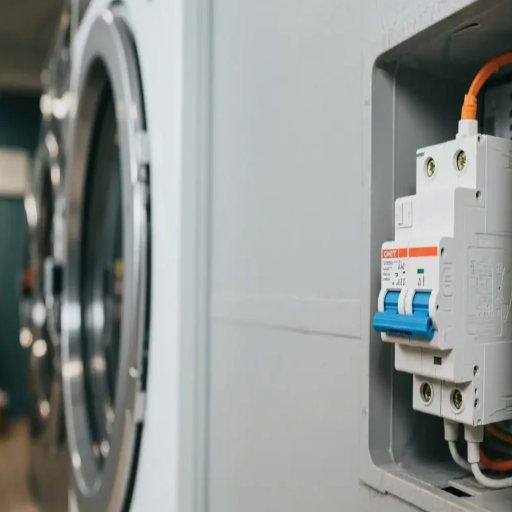
The washing machines usually require a dedicated 20-amp circuit so they can operate safely. Most modern washing machines draw between 8 and 12 amperes during operation, leaving some headroom to avoid overloading in the circuit. The 20-amp circuit finally provides power to the washing machine when maximum energy is requested, such as during the spin cycle, which demands extra wattage. Other high-energy-consuming appliances should not be plugged into this circuit; otherwise, it might trip or cause electrical hazards. Make sure to check the washing machine manual to follow any special electrical requirements. Additionally, make sure the circuit conforms to local electrical code.
How Much Electricity Does a Washer Actually Use?
A washer’s electricity consumption depends upon its size, efficiency, and usage pattern. Really, modern washing machines use anything between 400 to 1,200 watts in a load, somewhere from 0.4 to 1.2 kWh of electricity. Heat pumps/energy-efficient Energy Star washers on the lower end of the scale usually need less energy and water to wash than an older model would need. It also depends on the temperature of the water because hot water draws more energy. Run cold water cycles, fill each load, and maintain the washer regularly to get the cheapest electricity costs.
Running a Washing Machine with Alternative Power Sources
In theory and in practice, running a washing machine works well with alternative sources of power. Solar power is one of the alternatives; solar panels convert sunlight into electricity for the operation of the washing machine. This setup is ideal in places where the sun is shining almost daily, as it keeps grid dependency to a bare minimum. Wind, biogas, or any other form of renewable energy can run a washing machine through a generator. When using such alternative energy sources, it is essential that the power output corresponds to the washing machine’s requirements, or else it would result in malfunctions or inefficient working. Please always refer to the washing machine manual to see whether there are any guidelines for using non-conventional power sources.
Using Solar Panels to Power a Washer
When correctly designed, solar energy for running a washer presents a practical and eco-friendly solution. Perhaps one solution is a solar panel system of sufficient wattage to match the washing machines’ energy requirements (generally between 300 and 500 watts per cycle). The other important element is an inverter that converts DC power from the panels to the AC power needed by most washers. A battery bank could be used to store any excess energy generated to power the washer on cloudy days or at night. Before installation, determine the energy usage of your washing machine based on its rated power and the time length required for average washing cycles, then do your solar site selection. Also, make sure to review the washing machine’s manual for power ratings and to check for any specifics related to a solar-powered system. Install the system correctly and maintain it properly to achieve peak efficiency and long service life.
Portable Power Stations: Can They Run a Washing Machine?
Yes, a portable power station can be a run-a-washing-machine product; however, this requires careful consideration of the capacity of the power station and the energy needs of the machine. The portable power station must be able to generate power equal to or more than that required by the washing machine, especially during the spin cycle, which consumes the most power. One should be very sure that the power station must be fully charged and that it will sustain the needs of the washing machine throughout an entire wash cycle for the operation to be effective.
Reference Sources
“DC microgrid in residential buildings”
“Cost-effective smart metering system for the power consumption analysis of households”
Frequently Asked Questions (FAQs)
How much current is drawn by a washing machine?
Generally, a standard washing machine takes about 5 to 15 amps, depending upon its design and the load it is drawing. So a top loader, for instance, usually draws about 7.5 amps, and a front load would draw a similar rating or perhaps higher.
What are the running amps for washing machines?
Running amps for washing machines change according to the size and the capacity of the machine. Most residential washing machines draw a current of the order of 5-15 amps during the process, while small washing machines may require as little as 1-3 amperes in certain cases.
How much electricity does a washing machine consume?
Standard washing machines may require 300 to 1200 W for every washing cycle, depending on their make and how efficient they are. Knowing these numbers will help you find out how much electricity your washing machine uses during a workday.
Is it possible to run a washing machine with a Jackery solar generator?
Yes, a Jackery solar generator, such as the Jackery Explorer 2000 Plus or Explorer 2000 Plus Double Kit, can start a washing machine if the wattage ratings of the washing machine are within its limits. Just make sure that the washing machine’s startup amp draw does not overcloud the generator.
What is the startup amp requirement for a washing machine?
It is common to be higher than the running amps for washing machines, sometimes requiring an extra surge of power for a split second right when it starts working. It can range from 15 to 20 amps, depending on the particular model and motor efficiency.
How do I hook up a washing machine to a 240V outlet?
To hook up to a 240v outlet, make sure the washing machine is workable with 240v operation, use the correct outlet fixture, and make sure the electrical load on it does not exceed the circuit amp rating, which is usually 20 amps for a 240v outlet.
How do washing machine amps vary by model?
The quantity of amperage drawn by washing machines varies with various models. It might sometimes demand higher amperage for commercial washing machines than a typical residential model. Always check the voltage and wattage ratings from the manufacturer for specific information.
How do you save on electricity whenever you operate a washing machine?
Washing clothes during off-peak hours, selecting energy-efficient models, and washing only full loads would help save glorious electricity. Sometimes, washing machines working on the 240V supply might also save on electricity.”