








NYR(AL)Y/NAYR(AL)Y
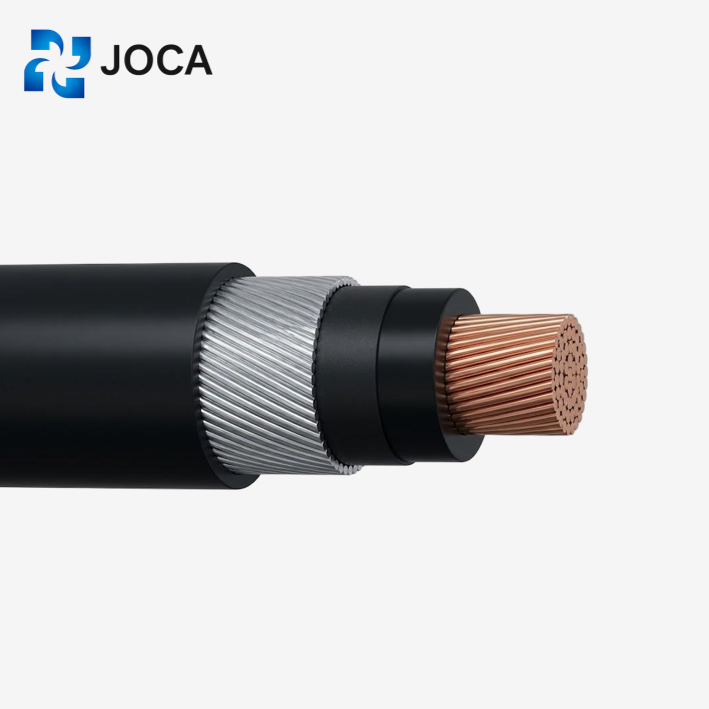
0.6/1kV Single core PVC Insulation Aluminum Wire Armoured and PVC Jacket power cable
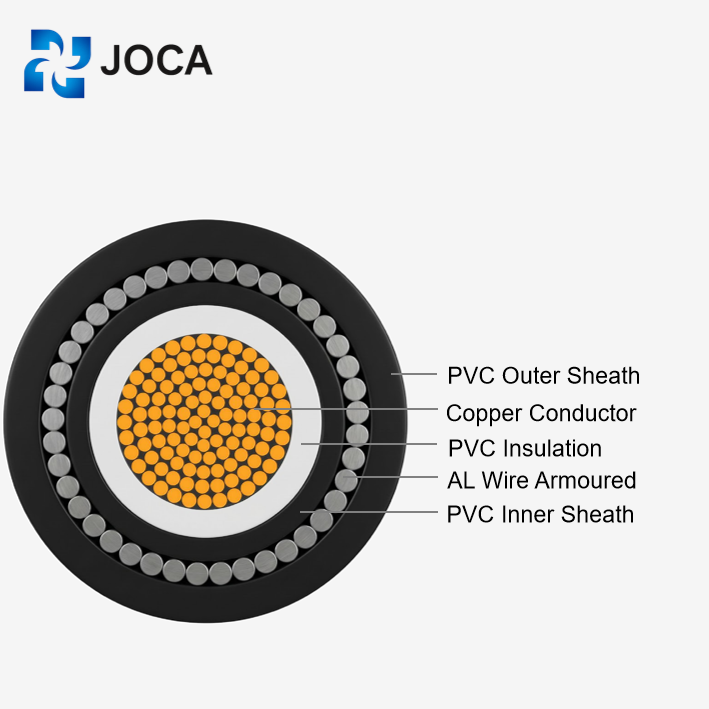
Conductor: Copper or Aluminum
Insulation: PVC
Inner Sheath: PVC
Armoured:Aluminum Wire Armour
Outer Sheath: PVC
Standards: IEC 60502-1
- Fast Sample Processing with Customized Solutions
- High-Quality Materials
- Affordable Price Options
- Global Delivery
- For better data protection, make sure that all uploads are secure
Save at least 30% on average
-
Product Description
Armored Cable SWA AWA STA : Product Description and Specifications
The NYR(AL)Y series is built for Single-Core distribution runs.Here’s the physics: You can’t use steel armor on a single-core AC cable. It creates a magnetic field that overheats the armor (induction effect). That’s why we use Aluminum Wire Armor (AWA). It’s non-magnetic. You get a rock-hard mechanical cage for direct burial, but without the heating issues.Your Options: Copper or Aluminum conductors. Need LSZH for fire safety or PE for wet soil? Just specify it, and we’ll extrude it.
-
Advantages
Armored Cable SWA AWA STA: Benefits and Features
Why Aluminum Armor (AWA)? Simple physics. Steel armor turns single-core cables into induction heaters. Aluminum is non-magnetic, so it stops the cable from cooking itself while still acting like a mechanical cage.
Copper or Aluminum: Your call. Go Copper (NYR) for raw power or Aluminum (NAYR) to slash the project bill.
Built for Extremes: Runs from freezing -20°C to hot +90°C. Need it waterproof? Ask for PE. Need fire safety? We swap to LSZH.
Monster Loads: It’s a workhorse. Pushes up to 885A (in air) and survives massive 42.84 kA short circuits without melting.
IEC 60502-1: No cutting corners. We build it strictly by the global rulebook.
Dimensions/Parameters
0.6/1kV Copper Conductor Single Core PVC Insulation Aluminum Wire Armoured and PVC Jacket power cable
| Nom. Cross Sect. (mm2) | DC Resistance at 20°C (Ω/km) | AC Resistance at 70°C (Ω/km) | Inductance - Trefoil formation (mH/km) | Inductance - Flat formation (mH/km) | Current Capacity - Trefoil - in air (A) | Current Capacity - Trefoil - in ground (A) | Current Capacity - Flat - in air (A) | Current Capacity - Flat - in ground (A) | Short circuit current at 1 sec (kA) |
|---|---|---|---|---|---|---|---|---|---|
| 10 | 1.83 | 2.190 | 0.442 | 0.489 | 73 | 77 | 75 | 79 | 1.15 |
| 16 | 1.15 | 1.376 | 0.412 | 0.458 | 96 | 99 | 98 | 102 | 1.84 |
| 25 | 0.727 | 0.870 | 0.386 | 0.432 | 127 | 128 | 130 | 131 | 2.88 |
| 35 | 0.524 | 0.627 | 0.367 | 0.414 | 154 | 153 | 158 | 157 | 4.03 |
| 50 | 0.387 | 0.463 | 0.351 | 0.397 | 187 | 181 | 192 | 186 | 5.75 |
| 70 | 0.268 | 0.321 | 0.333 | 0.379 | 234 | 222 | 240 | 227 | 8.05 |
| 95 | 0.193 | 0.232 | 0.322 | 0.368 | 286 | 264 | 292 | 269 | 10.93 |
| 120 | 0.153 | 0.184 | 0.315 | 0.361 | 331 | 299 | 338 | 304 | 13.80 |
| 150 | 0.124 | 0.150 | 0.309 | 0.355 | 376 | 334 | 383 | 338 | 17.25 |
| 185 | 0.0991 | 0.120 | 0.302 | 0.348 | 431 | 375 | 438 | 378 | 21.28 |
| 240 | 0.0754 | 0.092 | 0.294 | 0.340 | 507 | 429 | 511 | 430 | 27.60 |
| 300 | 0.0601 | 0.075 | 0.293 | 0.340 | 573 | 472 | 573 | 468 | 34.50 |
| 400 | 0.0470 | 0.060 | 0.290 | 0.337 | 650 | 522 | 644 | 513 | 41.20 |
| 500 | 0.0366 | 0.048 | 0.284 | 0.330 | 732 | 573 | 719 | 557 | 51.50 |
| 630 | 0.0283 | 0.040 | 0.275 | 0.321 | 820 | 625 | 799 | 602 | 64.89 |
| 800 | 0.0221 | 0.033 | 0.275 | 0.321 | 883 | 651 | 851 | 620 | 82.40 |
0.6/1kV Aluminium Conductor Single Core PVC Insulation Aluminum Wire Armoured and PVC Jacket power cable
| Size (mm²) | Max. Conductor Resistance DC at 20°C (Ω/km) | Max. Conductor Resistance AC at 70°C (Ω/km) | Max. Current Capacity in air - Trefoil (A) | Max. Current Capacity in air - Flat (A) | Max. Current Capacity in ground - Trefoil (A) | Max. Current Capacity in ground - Flat (A) | Inductance (mH/km) | Max. Short circuit current at 1 sec. (kA) |
|---|---|---|---|---|---|---|---|---|
| 10 | 3.08 | 3.701 | 62 | 56 | 76 | 60 | 0.396 | 0.76 |
| 16 | 1.91 | 2.295 | 82 | 74 | 102 | 80 | 0.370 | 1.22 |
| 25 | 1.20 | 1.442 | 125 | 113 | 134 | 105 | 0.358 | 1.90 |
| 35 | 0.868 | 1.043 | 145 | 131 | 180 | 141 | 0.345 | 2.66 |
| 50 | 0.641 | 0.770 | 176 | 160 | 215 | 168 | 0.336 | 3.80 |
| 70 | 0.443 | 0.533 | 224 | 202 | 265 | 204 | 0.326 | 5.32 |
| 95 | 0.320 | 0.385 | 271 | 249 | 319 | 245 | 0.321 | 7.22 |
| 120 | 0.253 | 0.305 | 314 | 291 | 363 | 279 | 0.316 | 9.12 |
| 150 | 0.206 | 0.249 | 361 | 333 | 409 | 312 | 0.313 | 11.40 |
| 185 | 0.164 | 0.198 | 412 | 384 | 464 | 353 | 0.310 | 14.06 |
| 240 | 0.125 | 0.152 | 484 | 460 | 543 | 410 | 0.307 | 18.24 |
| 300 | 0.100 | 0.122 | 548 | 530 | 615 | 464 | 0.305 | 22.80 |
| 400 | 0.0778 | 0.096 | 666 | 642 | 719 | 538 | 0.302 | 27.20 |
| 500 | 0.0605 | 0.076 | 776 | 744 | 821 | 610 | 0.299 | 34.00 |
| 630 | 0.04699 | 0.061 | 885 | 854 | 888 | 696 | 0.293 | 42.84 |
-
Production Processes Of Power cable
To ensure superior quality, JOCA operates fully digitalized and automated production lines for power cables. Specifically, this comprehensive workflow covers conductor stranding, insulation extrusion, metallic screening, and final sheathing. Moreover, intelligent systems actively monitor each stage to ensure stable performance and consistent product quality. In addition, the factory utilizes advanced testing facilities, such as partial discharge testing, tensile testing, and spark testing. Consequently, these rigorous measures guarantee that every delivered cable strictly meets international standards.

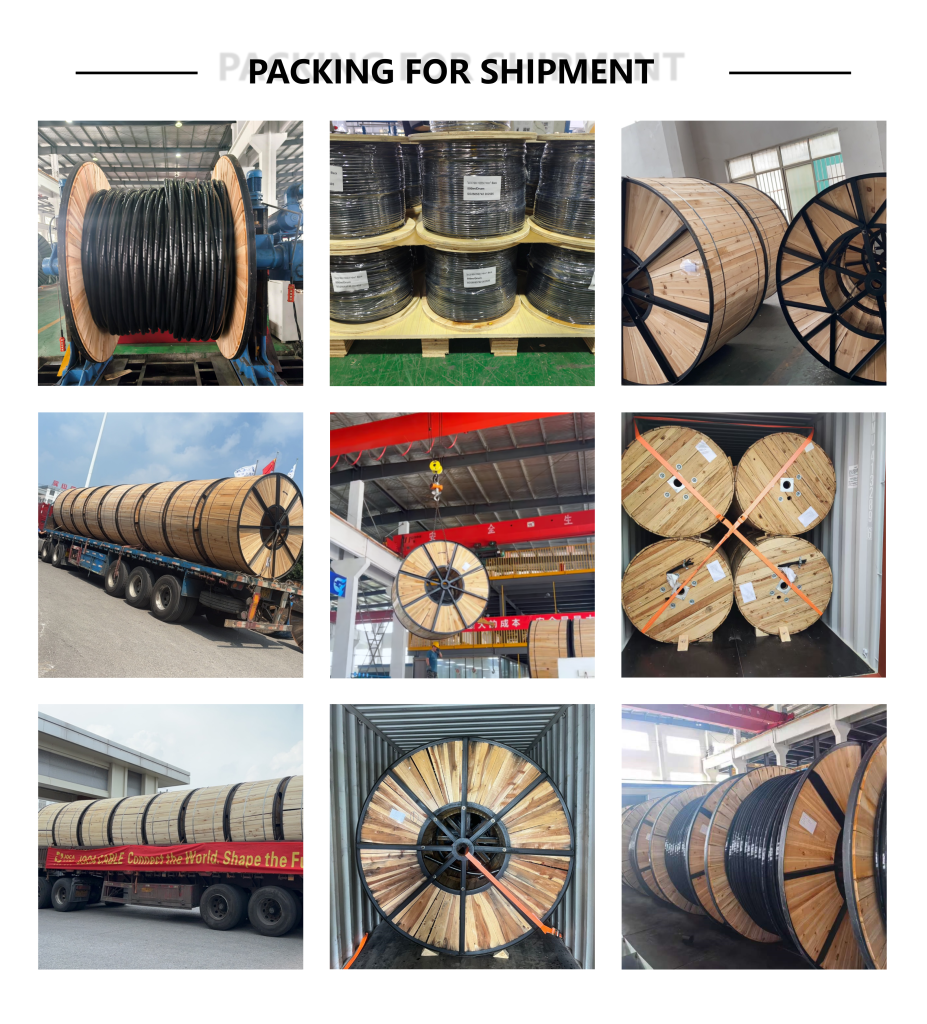
Packing For Shipment
To meet various transportation needs, there are many methods of packaging that can be used.
Have more questions?
Easily get started by finding the answers to commonly asked questions about our company and services.
Q: NYR vs. NAYR: What’s the difference?
A: Just the conductor metal. NYR is Copper. NAYR is Aluminum. That’s it. Aluminum is lighter and cheaper.
Q: Why use Aluminum Armor (AWA) instead of Steel?
A: To stop it from cooking. Steel is magnetic. On a single-core cable, steel armor turns into an induction heater. Aluminum is non-magnetic, so it protects the cable without the heat issues.
Q: Can I bury this underground?
A: Absolutely. That’s exactly what the armor is for—stopping rocks and soil pressure from crushing the core.
Q: Voltage rating?
A: Standard Low Voltage: 0.6/1kV.
Q: Can I change the sheath material?
A: Yep. Standard is PVC. Need it waterproof? Ask for PE. Need fire safety for a tunnel? Ask for LSZH. Just tell us what the job needs.
Q: Temp limits?
A: It handles extremes: from freezing -20°C all the way up to +90°C.
Q: Is it fireproof?
A: Only if you upgrade. Standard PVC burns. If you need flame resistance, you must specify the LSZH (Low Smoke Zero Halogen) version.
Q: What standard is this?
A: Strictly IEC 60502-1. We follow the global rulebook, no shortcuts.