






Introduction to Cat 8 Ethernet Cables
These days, the latest technology in an Ethernet cable basically entails the Cat 8 Ethernet cables for high-speed data transfer for applications demanding the maximum from the cable. The cable can attain bandwidth up to 2000 MHz and data transfer rates of 40 Gigabytes per second over short distances, usually maxing at 30 meters. These cables serve best in environments that need ultra-fast networking, such as data centers, high-performance financial systems, or gaming setups. Since Cat 8 cables support downward compatibility with any previous Ethernet standards, this flexibility makes them great for all sorts of applications. The shielding, along with advanced design, minimizes crosstalk and signal interference among cables to provide a connection of guaranteed stability and reliability.
What is Cat 8 Cable?
A Cat 8 is an Ethernet cable, which is basically the new and improved version of Ethernet technology for premium performance in the domain of high-speed connectivity. The cable can carry frequencies of bandwidths of up to 2000 MHz with data transfer speed capacity up to 40 Gbps over a distance of 30 meters. This makes it an ideal choice where ultra-fast and reliable access is desirable.
These cables incorporate excellent shielding for minimal EMI and crosstalk, offering utmost assurance of stability in the densely wired environments. Manufactured of materials of the highest quality, such as gold-plated connectors and thick copper conductors, these cables are designed for the most arduous usages. They find utility in data centers, enterprise networks, high-frequency trading systems, and residential setups where massive data transmission takes place in 4K or 8K streaming and online gaming alike.
Backward compatible with any previous Ethernet standard, like Cat 6A or Cat 7, Cat 8 offers a way of smoothly entering the existing network infrastructure. Though they are indeed enhanced, networks with a recommendation can only use them for short-distance connections because of the distance limitation imposed on optimal performance. With big data carrying capacities, Cat 8 cable has become quite future-ready against the growing demands of modern networking technologies.
Cat 8 Cable Specifications
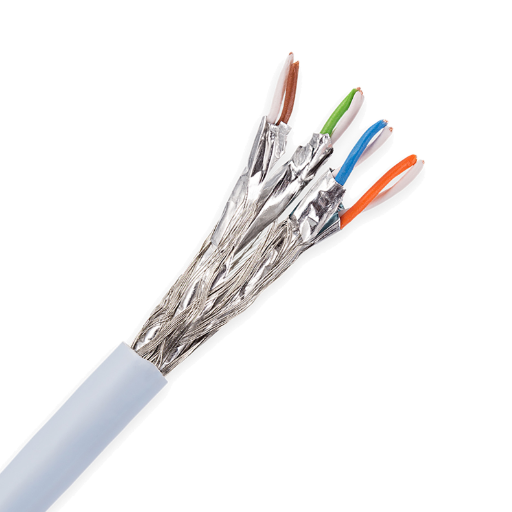
Primarily for lightning-fast data transfers, and these are the fundamental specifications:
| Specification | Cat 8 Performance |
|---|---|
| Bandwidth | Supports frequencies of up to 2,000 MHz |
| Data Transfer Rate | Achieves up to 40 Gbps over short distances (maximum 30 meters) |
| Cable Type | STP or shielded twisted pair, to afford better shielding against interference |
| Compatibility | Backward compatible with Cat 7 and earlier Ethernet standards |
| Connector Type | Typically RJ45; this junction type is the most convenient for integration on-site |
| Applications | Data centers, server rooms, and high-performance networking environments |
It is owing to these attributes that Cat 8 cables are considered ideal choices for those places where speed alone cannot overshadow reliability.
Key Features of Cat 8 Ethernet Cable
High Data Transfer Speeds
Having speeds support of up to 40 Gbps is a great improvement over the previous standards for Ethernet. Such high speeds make these cable types particularly suitable for use in high-performance applications such as data centers, server rooms, and advanced home networks.
High Bandwidth Capability
Having a bandwidth of up to 2 GHz (2000 MHz), Cat 8 cables give chances to the efficient transfer of substantial amounts of data at minimal latency. It serves well for environments that require real-time transmission of data.
Shielded Construction
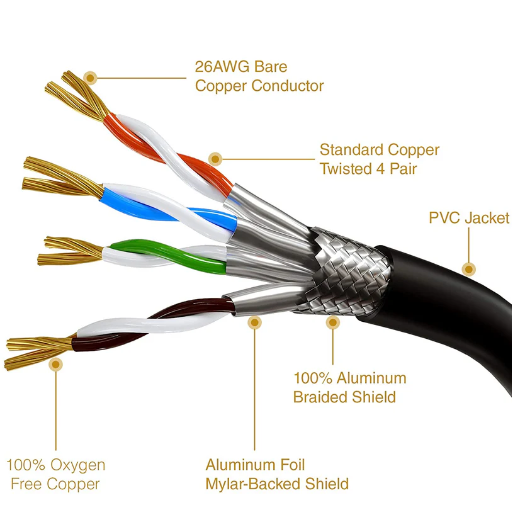
These cables come integrated with shielded twisted pairs (STP) and an additional protective shield wrapping the cable to curb signal crosstalk and electromagnetic interference (EMI). By so doing, a stable and reliable connection is offered even within an environment full of electronic devices.
Optimized for Short Distances
While optimized for short distances, Cat 8 cables theoretically provide the best performance for a distance of 30 meters, making them a practical choice for connecting devices in server racks or closely spaced networking equipment.
Backward Compatibility
Cat 8 is 100% backward compatible with all previous standards, such as Cat 6A and Cat 7, which means that older gear need not be instantly scrapped before setting up a new installation.
Durability and Material Quality
Designed to take a beating and receive constant use, Cat 8 Ethernet cables are constructed with the finest materials, such as gold-plated connectors and sturdy outer jackets, to afford them longevity and consistent performance over time.
Power-Over-Ethernet (PoE) Support
These allow powering devices through Ethernet, such as IP cameras or VoIP phones, with one cable conducting data and power to simplify installations.
Cat 8 cables have become a cutting-edge solution in Ethernet setups because they offer the speed, performance, and reliability required by data-heavy applications of today.
Importance of Shielding in Cat 8 Cables
The shielding in a Cat 8 Ethernet cable is an important aspect designed to protect against EMI and crosstalk, therefore protecting the data signals during their journey from the transmitter to the receiver. The interference possibilities are high with high frequencies, which can be transmitted in the Cat 8 range up to 2 GHz. The shielding, which usually consists of foil combined with braided layers, acts much like a Faraday cage in protecting the signal.
Shielded Cat 8 cables serve their purpose extremely well in places with high electromagnetic interference environments data centers, server rooms, or industrial environments. According to standards in the industry, shielding can reduce crosstalk by up to 95%, delivering stable performance even under the greatest severity of conditions; it also helps with longer cable runs, keeping speeds steady for applications such as 25 and 40 Gbps Ethernet.
In addition to this, the shielding adds to the cable’s durability by guarding against external abrasion or some form of damage that might impede performance. Due to this strength, these cables become good choices for long-term installations in professional and high-demand environments. Basically, shielded cables are superior to others in performance when combined with appropriate grounding, fulfilling the severe demands of the latest networking environments.
Bandwidth and Speed of Cat 8 Cable
Being a giant leap ahead in Ethernet networking technology, these frequently referred to as fast cables make way into modern, demanding environments. With such a furious bandwidth of 2000 MHz, Cat 8 clearly outperforms any former category. This huge available bandwidth minimizes the negative impact of latency on data signals, thus providing a smooth, continuous experience.
Maximum Data Transfer Speed
Bandwidth Frequency
Optimal Distance Range
While speed consideration puts Cat 8 up to 40 Gb/s for distances much shorter than 30 meters, it is most suitable for use in data centers and server-to-switch links and high-performance computing. Cat 8 is more highly shielded to ensure it handles these speeds better while reducing interference and maintaining data transmission quality.
So much for the specification of Cat 8 cables that allow them to cater to the emerging technologies like 4K and 8K video streaming, IoT devices, and advance cloud-based applications. These cables stand high on performance and reliability as a future-proof solution for any environment where speed and efficiency will be a priority.
Twisted Pair Design and Its Benefits
Being twisted-pair is a design considered basic to Ethernet cables, including Cat 8; such a design is also essential in reducing EMI and crosstalk. This method twists the two conductors of a single circuit, which cancels out noise and undesired signals from external sources. The tighter and more accurate the twists are, the better the cable can keep signal integrity over a longer distance.
Cat 8 cables make use of STP technology, which is a triple shield made up of individual shielding for each twisted pair and an overall cable shield. This provides the best possible protection against EMI and makes such cables the best in places with high electrical noise, e.g., data centers and industrial plants. The Cat 8 cables, for instance, are capable of supporting 2000 MHz bandwidths and data speeds of 40 Gbps at 30 meters, useful in any place where reliable high-speed connectivity is a must, even in the toughest of conditions.
Moreover, the enhanced shielding with twisted pairs offers durability and consistently lower attenuation levels. Namely, this set of features stands out in making Cat 8 cables–essentially high-data-bulk trains–fit for server-to-switch and for HD streaming applications. In either IT setups or homes, a proper combination of twisting and shielding maximizes performance and future stability.
Material Composition: Copper vs. Other Materials
For years, the copper used for Ethernet cables has been the preferred material, granted its excellent conductor with great dependability. Transmission of the signals is done well with minimum resistance given to it; copper materials perform well over distances, both short and long. In contrast to something like CCA-wire, pure copper wires in Cat 8 cables provide better signal quality and less latency. For example, whereas CCA is inexpensive, it has relatively high electrical resistance and correspondingly higher signal attenuation and reduced durability.
The ever-changing world of cables has seen the emergence of newer materials such as aluminum and optical fibers. Although lighter and less costly, aluminum does not offer a good level of conductivity as copper, thereby making it less suitable for Ethernet applications where speed of data transmission is of utmost importance. Fiber optics, by contrast, offers far more bandwidth and distance than either copper or aluminum wires. Fiber optic cables transmit information without degradation across at least tens of kilometers, thus presenting the best solution for long-distance communication and situations demanding ultrafast transmission.
A direct comparison according to cost and application scope would display trade-offs. Copper cables are cheaper, more flexible, and easier to install, but fiber optics provides unlimited data capacity and freedom from electromagnetic interference. The applications will largely decide which of the two materials is to be used. Copper is still dominant for combination setups and locations where medium speed is required, while fiber optics is usually the choice for enterprise-grade networks and backbone infrastructures.
Performance Comparison: Cat 8 vs Other Ethernet Cables
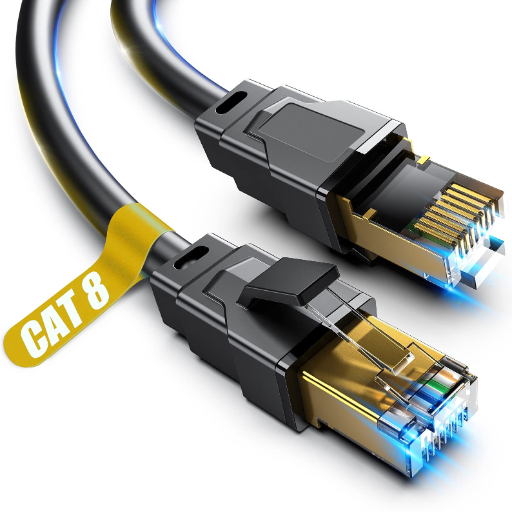
There is a catastrophe of words in choosing my own language when compared with Category 8 cables. This is the speed with which Cat 8 runs, transferring data at 40 Gbps for distances of 30 meters; therefore, it is a data-center cable or a high-speed network. It also has better shielding that prevents interference and keeps signals from deteriorating. Cat 6 and Cat 6a cables are used for speeds of up to 10 Gbps over greater distances in residential areas or small offices, but without the specialized shielding of Cat 8. For everyday users, categories lower than Cat 8 would just do, and Cat 8 stands out only in environments needing the highest speed with minimum latency.
Comparison with Cat 7 Ethernet Cables
Cat 7
Bandwidth: 600 MHz
Distance: Up to 100 meters
Shielding: Good (S/FTP)
Connectors: GG45 or TERA
Cat 8
Bandwidth: 2000 MHz
Distance: Up to 30 meters
Shielding: Superior (S/FTP)
Connectors: Standard RJ45
Cat 7 was meant to offer 10Gbps of data transfer speeds, same as Cat 6a, but with much more emphasis on shielding and performance in high-interference environments. With much lower bandwidth outputs of a mere 600MHz (versus contrasts with the stupendous 2000MHz of Cat 8!), Cat 7 is nowhere close to what Cat 8 offers and is much better suited for data-intensive applications and high-speed transfers over shorter distances.
Another difference rests in shielding. While both Cat 7 and 8 cables are well shielded against crosstalk and external interference, Cat 8 cables take the shielding category one step further with improvements such as individually shielded pairs (S/FTP) that maintain signal integrity in high-interference scenarios like in data centers. Cat 7 cables usually must use either GG45 or TERA connectors, which restricts their versatility as compared to Cat 8’s ability to be used with standard RJ45 connectors.
A Cat 8 cable is particularly optimized for instances where latency has to be kept to an absolute minimum and exorbitant data rates are necessary, such as in enterprise networking and server infrastructures. While Cat 7 cabling may be ideal for some home networks or small office setups that merely require stable and reliable speeds, Cat 8 stands tall as a future-proof solution for all high-grade network installations. Cat 8 assures top-notch performance for cable runs up to 30 meters in length, whereas Cat 7 is better suited for the longer runs, where hitting ultra-high bandwidth is not the major concern.
Speed Comparison: Cat 8 vs Cat 6A
Cat 6A
Bandwidth: 500 MHz
Distance: Up to 100 meters
Cost: Moderate
Use Case: General office setups
Cat 8
Bandwidth: 2000 MHz
Distance: Up to 30 meters
Cost: Higher
Use Case: Data centers, gaming
Cat 8 and Cat 6A cables are designed to support high-speed data transmissions, but the performance profiles are quite different in their unique ways. The Cat 6A cables can offer bandwidths all the way up to 500 MHz and speeds of at most 10 Gbps on cable distances that can go as long as 100 meters. These would very well suit a general office setup or any environment that calls for longer cable runs.
On the flip side, the Cat 8 cable blatantly outperforms the Cat 6A as far as bandwidth and data transmission speeds are concerned. Consider the numbers in yourself: 2,000 MHz bandwidth and speeds of up to 40 Gbps. The 8s thus necessarily sit in the realm of front-line applications, data-intensive environments such as data centers, server rooms, and high-end gaming applications. Limitation-wise, with the 30-meter max, one also takes his time to carefully consider installation planning.
Shields in Cat 8 cables further contribute toward eliminating crosstalk and electromagnetic interference, even more than in Cat 6A, allowing for faster and more reliable connections when the environment poses higher network traffic or electrical noise. While Cat 6A presents a cost-effective option for practically any standard application, Cat 8 is the choice when the time ahead is considered and performance is beyond ultra-high.
Category 8 Standard: What to Expect
In the realm of wired networking technologies, Cat 8 Ethernet cables are the newest form present and provide performance paralleled to high-speed data transmission. Offering much higher potential operating frequencies- up to 2000 MHz as against 500 MHz for the Cat 6A- they provide a magnificent contrast. With its high-speed data transfer capacity of 40 Gbps up to 30 meters, Cat-8 perfectly serves data centers, server rooms, and other top-performance environments.
Shielding in Cat 8 cables is built to defeat signal loss by crosstalk and EMI, usually by using an S/FTP (Shielded and Foiled Twisted Pair) method, which makes it a perfect choice for installations in which many high-frequency cables run close to one another. Its rugged construction is mostly tested under the ISO/IEC 11801 and TIA-568 standards for assuring uniform and dependable performance under all international specifications.
Typical situations for Cat 8 cables include switch-to-switch connections, interlinks between short-range servers, and any network interface that demands low latency, high bandwidth, and utmost data efficiency. In addition to Cat 8, owing to its initial cost being higher in deployment price than older categories like Cat 6A, Cat 8 may be absolutely worth it where time-proving and scaling benefits are needed for most critical applications.
Applications of Cat 8 Ethernet Cables
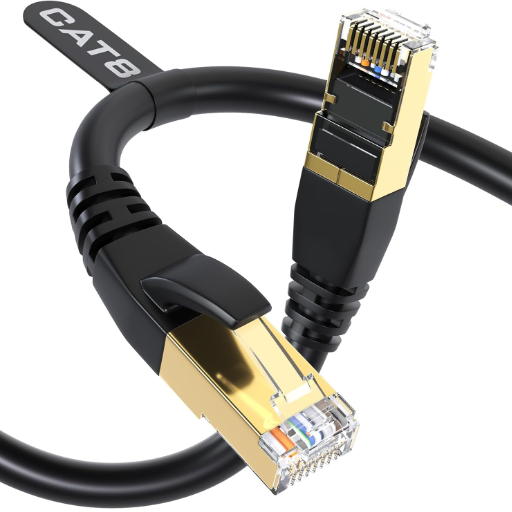
Cat 8 cables find their principal applications in high-speed data centers, enterprise-level networking, and situations ideally requiring near-zero latency. These are quite suited for interconnecting switches, routers, and servers over short distances of not more than about 30 meters. They carry bandwidth-intensive applications such as Video Streaming, Cloud Computing, and Online Gaming, allowing the smooth and efficient transmission of data.
Ideal Usage in Data Centers
Data Center Applications
Cat 8 Ethernet cables are very much suited to the state-of-the-art data centers as they go for a speed of 40 Gbps data transmission. Such ultra-high speed working with 2000 MHz of maximum bandwidth makes them perfect for supporting high-performance computing and server communication. These are shielded so they protect against interference and crosstalk, giving utmost stable connection to an environment full of dense networks.
In modern times, greater and greater usage of Cat 8 cables has been made in data centers for connecting the top-of-rack switches down to the servers or in short-distance connections for high-frequency applications. The 30-meter range of the cables makes it an ideal length for data centers, as shorter cable runs of this type are common. The low latency factor of Cat 8 cable speeds up the processing of packets so that applications like real-time analytics, virtualization, and cloud computing go on without any hitch.
The installation of Cat 8 cables is an important step toward making data centers future-proof with the mounting needs for speed and downtime. With global demand for data processing projected to increase at a double-digit rate of approximately 10% from 2023 to 2028, Cat 8 Ethernet cables are what next-generation network infrastructure needs for scalability and performance.
Advantages of Cat 8 for Gaming
Gaming Performance Benefits
Now, Cat 8 cables give the very best of performances to gamers by ultra-fast data transfer speeds of 40 Gbps at the bandwidth frequency of 2 GHz. This opens up smooth use of applications, with lower latencies, and during high-speed online gaming instances, creating that essential advantage for the gamer. Unlike wireless networks with their root interferences or distance from a router, a Cat 8 cable would provide the desired stability of a wired connection, useful for making a quick decision in multiplayer games.
Also, just because of their low EMI property, Cat 8s allow uninterrupted gaming by keeping signal integrity intact even when so many electronic devices abound around. This is a boon to the gamers streaming their gameplay as the strong connection supports high-quality, uninterrupted uploading of the gameplay without any degradation.
About gaming setups that are rapidly evolving, the cable serves as an investment since it is future-ready. As files for games become bigger and many more games adopt 4K and 8K graphics, Cat 8 will prove useful for high-speed data transmission for these demanding applications. For example, an average game download can exceed 100 GB, emphasizing the need for faster connections just to minimize wait times.
For hosting private gaming servers and VR gaming, Cat 8 improves the response and realness of data transfer by allowing for higher data transfer rates and alleviating network bottlenecks. With a robust design including, in many cases, shielded twisted pairs, it will give you much more durability and serve you as a long-term solution.
Best Practices for Installation
Installation Guidelines
When installation of Cat 8 Ethernet cables is done, it is imperative to plan and execute meticulously to ensure network performance is optimal and the longevity of the cables. Some important pointers are listed here:
- Pick the Right Length: Measure the distance between your devices and be sure to choose the cable of that exact length. Cat 8 cables support speeds of up to 40 Gbps over a maximum cable length of 30 meters (98 feet); hence, it becomes imperative to keep the cable lengths well within this limit for the best performance.
- Avoid any sort of signal interference: Bear in mind the usual electromagnetic interference would result in signal loss or degradation; keep all cables clear of electrical wiring, fluorescent lightings, and other such sources of interference. Though Cat 8 cables frequently use shielded twisted pair technology to counter interference, good layout design will only work towards improving their efficiency.
- Proper Cable Management: Secure and arrange cables using cable organizers or Velcro ties. Make sure not to sharply bend or stretch cables, as it could damage the internal wires and affect performance of the cable. Ideally, the bending radius should conform to the recommendations of the manufacturer.
- Secure and Compatible Connectors: Use RJ45 connectors for Cat 8 cables to avoid compatibility and fit issues. Use a tight connection to the port to avoid any accidental disconnections that could disrupt network activities.
- Temperature and Environmental Conditions: Store and install the cables in an environment that will not experience excessive temperatures or moisture conditions. Even though Cat 8 cables are considered to be more rugged than their predecessors, the performance may degenerate over time if subjected continuously to adverse conditions.
- Test the Network After Installation: Yes, after installation, network testing should be performed using a cable tester or a network analyzer. This confirms that the cables are sending data at the speed they are supposed to and also detects any issues that may arise.
Following these procedures will help you get the best performance and longevity out of your Cat 8 Ethernet cables while providing a stable, efficient network that meets the requirements of intense activities such as gaming, streaming, and data-heavy business working.
Choosing the Best Cat 8 Cable
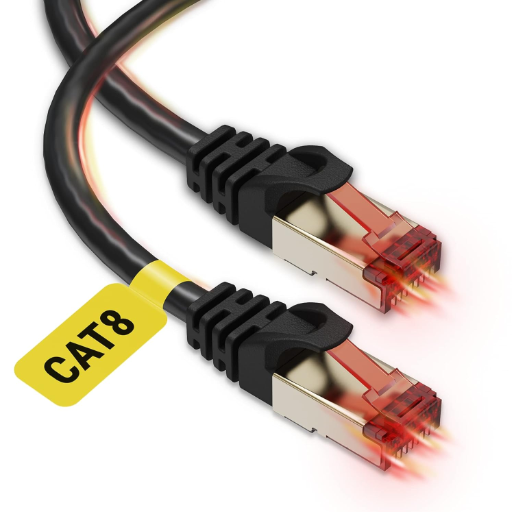
Length: Consider a lesser length of the cable so that it fits well in your setup without extra slack, as longer cables tend to reduce performance ever so slightly.
Shielding: Assess any good shielding, so the cable will not suffer from interference and noise in an area surrounded by many electronic devices.
Build Quality: Go for a cable that has sturdy construction and gold-plated connectors, which contribute to better electrical conductivity and longer life.
Certified: It is recommended for maximum performance to ensure that the cable is certified for Cat 8 standards, capable of speeds up to 40 Gbps and frequencies of up to 2 GHz.
Application: The next priority is the application; it could be gaming, streaming, or enterprise networks. Whatever it might be, you have to pick the right cable for your job.
When you put these into consideration, you will be making a recommendation for the best-performing cable with reliability for the network.
Features to Look for in a Cat 8 Ethernet Cable
When picking out a Cat 8 Ethernet cable, you want to consider this checklist of features:
- Shielding: Look for good shielding on the Cat 8 cable, such as S/FTP (Shielded Foiled Twisted Pair), to stop interference and keep the signal clear, particularly in an EMI-filled environment.
- Bandwidth and Speed: The cable should be capable of working at a bandwidth of up to 2 GHz (2000 MHz) and capable of transferring data at a speed of up to 40 Gbps for maximum performance across current-generation applications like gaming and 4K video streaming.
- Build Quality: Durable materials, snagless ones, and gold plating on the connector to avoid corrosion and to ensure long-lasting service should be preferred. Also, premium-grade copper conductors are extremely important in reducing the degree of signal loss.
- Length & Flexibility: Pick the correct length for a given setup; too short or too long might impact performance. Flexibility aids the installation process in tight spaces.
- Certifications: Check to see if it meets the official Cat 8 Standard (ANSI/TIA-568-C.2-1) and is UL Listed or ETL Verified to assure compliance with the industry standards.
- Compatibility: Make sure it is backward compatible with prior categories (Cat 6A, Cat 6, Cat 5e) for greater versatility and smooth integration with existing networks.
Considering these aspects will help you pick a Cat 8 Ethernet cable that fits your needs in terms of connectivity, coupled with the best speed, reliability, and sturdiness.
Top Brands and Recommendations
Recommended Cat 8 Cable Brands
Among the best brands for Cat 8 Ethernet cables, consider options from Cable Matters, Vandesail, and Jadaol-that is what I do. From my experience, Cable Matters gives outstanding performance and durability, while Vandesail is more of a reliable yet cheaper choice. Jadaol is fabulous for the flat cable and neat installations. These brands always put out quality-grade products that match industry standards, hence trustworthy choices for all high-speed networking needs.
Cost Considerations and Value
Budget Planning for Cat 8 Cables
The cost of networking cables depends on the brand, so you should try to balance price and quality to get the right value for what you need. Usually, Cat 5e cables are the cheapest but cannot match the speeds and bandwidths of newer variants like Cat 6 and Cat 6a, which usually carry a slightly higher price. For instance, a typical Cat 6 for a 10-foot cable can set you back somewhere around $10 and $15, while for a Cat 7 or Cat 8, prices can range from storage and $20 to $30 depending on length and brand.
By spending a little more on higher-category cables, you are purchasing enhanced performance and, in essence, future-proofing your setup to accommodate higher internet speeds. Brands like Cable Matters, Vandesail, and Jadaol provide less mærconditioning methodology to some competitively priced cables about sturdiness and functionality. Since Jadaol flat cables offer both good looks and smooth installations at an affordable price, they are the way to go if aesthetics matter.
If the most cost-sensible solutions are to be considered, multi-pack options should be purchased, which usually reduce the cost per cable. Also, check for manufacturer warranties and write-ups to make sure that the product can consistently perform at the advertised price. Always evaluate your individual networking needs to find the most appropriate cable within your price range.
Reference Sources
“Evaluation of 10G Ethernet under various environments”
“Toughness of augmented cables for Ethernet technology assessment”
“Ethernet networks: design, implementation, operation, management”
Frequently Asked Questions (FAQs)
How does a CAT-8 cable differ from a CAT-7 cable and a CAT-6a cable?
CAT-8 cables feature a higher speed of data transmission, higher than that of CAT-7 and CAT-6a cables. While CAT-7 supports speeds of up to 10 Gbps for a maximum distance of 100 meters, CAT-6a does 10 Gbps for 100 meters. Operating at the top speed of 40 Gbps for low distances, CAT-8 prevails in high-performance networking.
Why should I upgrade to a Cat 8 Ethernet cable?
Here, the upgrade to Cat 8 Ethernet cable is good if you want the faster rate of data transmission and bandwidth, be it for gaming, streaming, or running data centers. These cables support power over Ethernet (PoE) and are fastest, hence best for a future-proofed network.
How good would Cat 8 Ethernet cables be?
There are many advantages of using Cat 8 Ethernet cables, such as carrying the highest possible Ethernet speeds of up to 40 Gbps, less latency, and shielding against interference. These cables are good for scenarios where performance and reliability are paramount: data centers and server rooms. Also, they support Power over Ethernet, making them useful for many applications.
How would the maximum length affect the performance of Cat 8 cable?
The maximum permanent link length for a Cat 8 cable is 30 m, which is shorter when compared to older categories such as Cat 6 and 7. This shorter length ensures that high performance and speed are maintained so that the cable is capable of supporting the required data rates without any degradation. For longer distances, options such as switches and extenders will need to be considered.
Are Cat 8 Ethernet cables good for gaming?
Absolutely, Cat 8 Ethernet cables are perfect for gaming because of their speeds and little to no latency. Since they are the fastest Ethernet cables available, they offer the smoothest online gaming experience without any lag. If you are a serious gamer, then a Cat 8 cable would indeed be the perfect upgrade to enhance your overall performance and connectivity.
What is the relevance of the IEEE standard in copper Ethernet cables?
The IEEE standard ensures that copper Ethernet cables, including Cat 8, meet certain performance criteria and are compatible with various networking equipment. Such standardization is vital to ensuring the unaltered speed, reliability, and operation of different devices and network setups.
What kinds of cables are available for different applications?
There are several types of Ethernet cables, like Cat 5e, Cat 6, Cat 6a, Cat 7, and Cat 8. Each category boasts a different speed, bandwidth, and maximum length. Cat 5e, for example, might cater to simple applications like home networking, whereas Cat 8 is designed for big data centers and applications where the fastest Ethernet connection needs to be attained.