







Product safety is especially important in the electrical and electronic component industry, where flammability standards ensure the material or the product complies with regulations and offers protection to the end user. UL 94 is one of the most recognized standards anywhere around the globe for classifying plastic materials based on their fire resistance properties, with the application of these materials in devices and components. The knowledge of these classes is important for manufacturers who want to compete in the general industrial arena with gained certification, and for engineers and product designers who want to make proper material choices. This article aims to discuss the key aspects of UL-94, breaking down its classifications and test methods to provide a comprehensive guide towards understanding this important safety standard.
Introduction to UL 94 Flammability Standards

An important safety rating system, this standard classifies polymer materials according to their response to ignition sources by some criteria, such as how fast they burn, how fast the flame spreads, and how well the material can extinguish the flame. It essentially tests the material by either a horizontal burning test or a vertical burning test, V-0, V-1, or V-2. Manufacturers, engineers, and product designers use these classifications to select materials suitable for various applications while complying with safety and regulatory responsibilities.
What is UL 94?
UL 94 is a widely accepted safety standard serving as a test for flammability issued by Underwriters Laboratories (UL) for plastic materials used in electrical devices, appliances, and products. UL 94 is a test to evaluate the reaction of the material to controlled sources of ignition to create the basis of a uniform system of classification of flammability. Testing under UL 94 involves methods of horizontal and vertical burns to observe the behavior relative to burning rate, spread of flame, and the capacity for self-extinction. Classifications including HB, V-0, V-1, and V-2 help product designers and manufacturers select materials that comply with appropriate safety and regulatory standards in a broad range of applications. When a product is UL 94 certified, it can be guaranteed to be safe and perform suitably.
Importance of Flammability Standards
Flammability standards are a key issue of safety and usability for materials in commercial and industrial uses. They minimize the fire hazard by establishing definable criteria under which materials perform when exposed to flames. For example, these standards identify materials that will resist or self-extinguish fire, thus protecting against injuries, property damage, or loss of life during fire incidents. UL 94, perhaps the best recognized flammability standard, offers a number of specific classifications, such as HB, V-0, V-1, and V-2, which guide product design decisions for varying industries-from electronics to automotive. Compliance with flammability standards will also go a long way toward meeting regulatory requirements; they build consumer trust and enhance the safety profile of products.
Overview of UL 94 Classification
UL 94: The Standard for Safety of Flammability of Plastic Materials for Parts in Devices and Appliances is a method widely recognized by which an institute evaluates the flammability properties of plastics by considering burning behavior under a laboratory setup. The main classifications in the UL 94 are:
HB (Horizontal Burn)
Slowest flammability level, where the material burns less than 76 mm/min if the specimen is less than 3 mm thick. For lower fire safety requirements.
V-0 (Vertical Burn)
The material must extinguish itself within 10 seconds of being ignited and cannot drip flaming particles.
V-1 (Vertical Burn)
The material extinguishes itself within 30 seconds and may drip particles, provided they are not on fire for more than five seconds.
V-2 (Vertical Burn)
Same as V-1 except that dripping of flaming particles is permitted for a longer time and may cause ignition of cotton below it.
These classifications derive from actual testing methods, such as vertical and horizontal burning tests, that determine how long a material resists burning, how fast it burns, or even if it self-extinguishes. A UL 94 rating is popularly used by manufacturers in the selection of plastics for various consumer products to ensure safe use. Some of these products would be electrical enclosures, automotive parts, and household appliances. The knowledge of and compliance with UL 94 guarantee stringent safety standards for the materials, thereby reducing flammability risks and making the product safer and reliable.
Types of UL 94 Flame Ratings
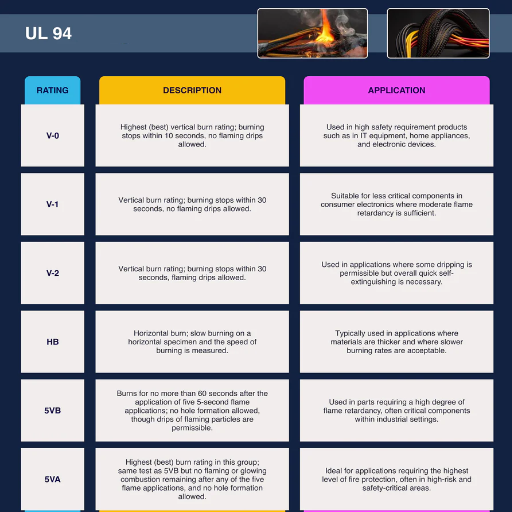
Based on the burning properties of plastics, different flame ratings come within the UL 94 standards:
| Rating | Test Method | Requirements | Applications |
|---|---|---|---|
| HB | Horizontal Burning | Controlled burn rate, self-extinguishing within time frame | Low fire risk applications |
| V-0 | Vertical Burning | Extinguish within 10 seconds, no flaming drips | High safety requirements |
| V-1 | Vertical Burning | Extinguish within 30 seconds, limited dripping | Moderate safety applications |
| V-2 | Vertical Burning | Extinguish within 30 seconds, flaming drips allowed | Basic fire resistance needs |
| 5VA/5VB | Vertical Burning (Rigorous) | Higher flame exposure, minimal damage | Critical safety applications |
Vertical Burning Test Explained
The Vertical Burning Test is a standardly method to check the flammability of plastic and polymer materials in a vertical setting. Under this test, the specimen is held in a controlled flame for a given amount of time and is observed to see how it ignites, burns, extinguishes, or drips. The primary goal is to determine how the material resists combustion and the spread of fire, important from a safety standpoint on applications such as electrical enclosures, automotive parts, and aerospace components.
After the flame is removed, any relevant indicator is whether the material self-extinguishes, the duration of the after-flame or after-glow, or whether flaming drips take place, which can ignite the materials beneath. The rating of V-0 of any material implies the very best resistance against flames that can be offered in the vertical test; V-1 and then V-2 are further lowered in their degree of flame resistance. This test, therefore, confirms the acceptance of any global safety standards and, because of that, acts as an important function when selecting a material meant for and approved for hazardous environments.
Horizontal Burning Test Explained
Horizontal Burning Test (HB) measures the flammability of materials when subjected to a horizontal flame. This test measures the rate at which the material combusts off under certain conditions. The specimen is mounted horizontally and exposed to an open flame for a definite period while the rate of burning (as it supports its own combustion) is recorded. For a material to be considered passing, the burning rate should be less than 40 mm per minute for samples of thickness 3-13 mm, or else it should self-extinguish before burning 100 mm. The failure to meet any of these criteria denotes poor fire resistance. UL 94 HB is usually used for materials that would get into low fire-risk situations and is also the basic criterion to ensure safety standards in many industries.
Understanding Different Flame Ratings
Materials and Flame Retardance

When speaking of flame retardance in materials, it behooves one to weigh the peculiarities relevant to the purpose intended. Given the chance to select materials that are UL 94 certified, the chances of fire-related incidents will certainly go down significantly. In such high-risk surroundings, the use of V-0 or V-2 (according to ISO) or 5VA or 5VB materials should be considered, as these classifications imply that the material has the best resistance to being exposed to flame-intensive files. Conversely, depending on the lower hazard of the application, materials with HB or V-2 ratings may be satisfactory. Such knowledge would provide an informed choice between materials with safety standards and the durability of the end product.
Impact of Material Thickness on Flammability
Thickness always influences the flammability, and in fact, is a major determiner in the general fire resistance of a product made of a certain material. Thicker materials bear lower rates of ignition and flame spread, being that higher thermal mass prevents heat penetration and combustion from being established nearly immediately. To cite the UL 94 type of analysis for flammability as an example: the thinnest samples would be the worst flame ratings-prone to ignition and flame propagation much more when compared to thick samples under similar test conditions. The relationship, however, is not necessarily linear, since the formulations and chemical composition of certain materials can affect their behavior under varied thicknesses. Thus, in the critical selection of materials, designers should always consider thickness along with other factors, including the type of material and environmental conditions, to ensure the satisfaction of fire safety requirements and ideal serviceability.
Classifying Materials by Flame Resistance
Materials can be classified according to their flame resistance, combustive behavior, and performance under standardized testing conditions. The commonly used classifications are flame-retardant, inherently non-flammable, and combustible. Some common standards examine materials for their resistance to ignition, to flame propagation, to smoke generation, and heat release rates: UL 94, ASTM E84, and ISO 11925-2.
- Flame-retardant materials are usually treated with additives, such as halogen, phosphate-based chemicals, or intumescent coatings, which diminish combustion or delay it. Some examples include plastics and textiles treated to be flame-retardant.
- Inherently non-flammable materials, such as steel, concrete, and some ceramics, are possessed of an extremely high resistance to combustion owing to their stand-alone properties.
- Combustible materials, such as untreated wood and polymers, will ignite and burn under various sets of conditions. For these, design alternatives or some form of barriers need to be imposed.
The fire classification of materials is central to fire regulation compliance and is dependent on the intended use of such a material, its susceptibility to possible effects of ignition sources, and environmental conditions. Designers shall look at test results wherever applicable to select materials according to the specific requirements of fire resistance.
Flame Retardant Materials and Their Applications
Flame-retardant materials are engineered to slow or stop fire propagation in different environments and industries, thereby playing an important role in safety enhancement. Generally, these materials undergo chemical treatment or have inherent attributes that grant them resistance against fire so as to resist high temperatures and flammable factors. Examples of such substances are halogenated compounds, phosphorus-based retardants, and mineral-based solutions such as aluminum hydroxide. Other materials, which are actually inherently flame-retardant, are certain thermoplastics that are designed to self-extinguish with the removal of an ignition source.
Some common uses of flame retardants are across various industries. In construction, they are incorporated into insulation, carpets, and claddings to minimize fire hazards to homes and businesses. Automotive and aerospace sectors require flame-retardant plastics and composites to strictly comply with safety standards for interior components. Consumer electronics require flame retardants for circuit boards, casings, and even cables to prevent ignition in high-heat areas. Standard codes and safety certifications, such as UL 94 or NFPA 701, guarantee that a material fulfills specific levels of fire performance for its intended use. Studies into the effectiveness and environmental impacts of the materials are carried out continually, in correlation with developments in technology and legislative requirements.
UL 94 Testing Procedures
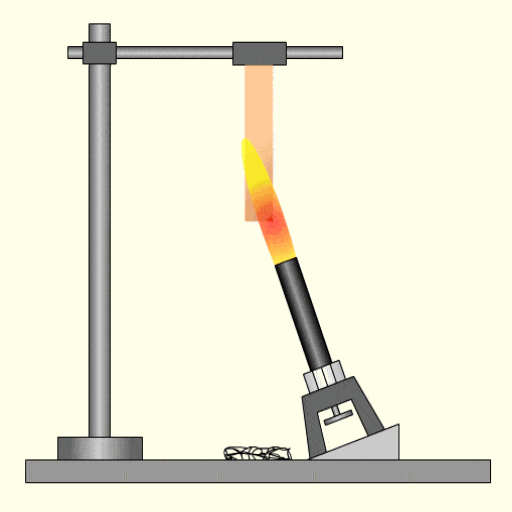
UL 94 testing procedures inspect how plastic materials react to fire under various conditions in their application. Parameters typically considered are ignition resistance, flame spreading, and dripping, all under controlled atmospheric conditions. Thus, two broad categories of the tests include vertical burning (e.g., V-0, V-1, V-2), which considers the ability to self-extinguish, and horizontal burning (e.g., HB), which considers the capacity to resist flame propagation. Each test has a standard approach that involves subjecting the specimens to a flame for a specified time and then recording the amount of time it continued to burn after removal of the flame, the period it glowed, and whether it held together. These classifications guarantee that in given applications, a material will indeed have to perform to combat fire hazards.
Overview of the Burn Test Methods
Burn test methods are used to study the response of materials when exposed to fire and determine their fire resistance ratings. The principal tests include the vertical and horizontal burning tests, e.g., the UL 94 tests. The vertical burning tests (V-0, V-1, V-2) basically investigate the material’s capability to self-extinguish after it is exposed to flame, where the parameters include the time of after-flame, dripping behavior, and after-glow time. On the contrary, the horizontal burning test (HB) studies the resistance of a material to the spreading of a flame region on it while being ignited horizontally. In this test, the materials are exposed to very particular flame conditions for precise intervals of time, after which the burn rate of the material is calculated or a classification is assigned to it based on the observed performance. Using these results, researchers as well as manufacturers may confidently ensure that the products conform to the regulatory safety standards and that they work satisfactorily in their intended application areas, like electronics, construction, and transportation, to name a few, where fire safety becomes significant.
Key Factors in Conducting Flame Tests
Before performing any flame tests, there are several aspects that must be taken into account so that the results can be accurate and dependable.
- Material Preparation and Conditioning: Test samples ought to be prepared according to specific dimensions and be conditioned in a controlled environment of a certain temperature and possibly also humidity before conducting the test. Such preparation will help minimize variability and maximize repeatability.
- Test Environment: During testing, the environment should be kept controlled so that factors like airflow normalization, ambient temperature, or humidity fluctuations do not interfere with the flame’s behavior or how the material reacts to ignition.
- Flame Source Specifications: The flame source, including temperature, pressure, and fuel-air ratios, must be consistent with the stated test requirements according to either ASTM or ISO specifications. For unreproducible settings, flame characteristics must vary.
- Parameters for Measurement: During the test, ignition time, flame spread rate, afterburn duration, and char length should be accurately measured. Such measurements are necessary to determine the fire performance classification of the material.
The standard compliance of flame tests is important to generate results that are comparable and certifiable. Standards (like ASTM E84, UL 94, or ISO 11925-2) lay out different protocols depending on the ultimate application of the product.
Through such factors, a tester can be certain that flame tests will provide solutions that can be used in evaluating a material’s fire resistance, allowing decisions to be made regarding a product’s safety and compliance.
Interpreting Test Results
Though there is no single formula for interpreting flame test results, any approach taken should conclude the performance of the material, as tested, under fire exposure. A few parameters to be considered in analyzing would be flame spread rating, smoke development, ignition time, and heat release rate to conclude compliance with the corresponding safety standard. The lower the number, rating-wise, the better the fire resistance that is provided, which is necessary for safety-critical applications like construction or transportation industries.
Since the color changes seen during the flame test can give clues about the elemental composition of the material, this principle is especially helpful when analyzing trace elements or contaminants. Understanding that ASTM E84 or UL 94 are paired with test results means that test conditions must be consistent to conduct an accurate comparison. After combining test results with regulatory standards, the professionals can determine whether the material can be employed for certain uses or should be modified further to achieve better fire resistance.
Applications of UL 94 Standards
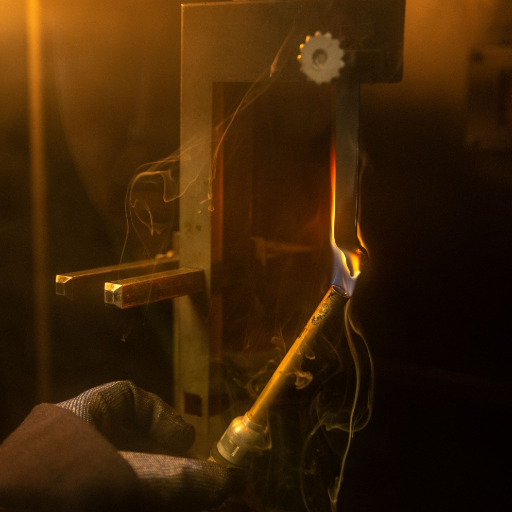
The UL 94 standards, being among the most commonly applied to determine the flammability properties of plastic materials for use in electronic devices, appliances, and other industrial applications, assist manufacturers in figuring out whether a material can withstand ignition and combustion and in their own design choices toward safety-critical components. For instance, materials of higher UL 94 ratings, like V-0, can serve to reduce the flame spread and provide self-extinguishing characteristics; such traits are necessary for meeting safety regulations. Furthermore, UL 94 classes serve to assist developers in ensuring that their products meet the worldwide safety requirements necessary to minimize risks associated with fire hazards in their final applications.
Industries that Require UL 94 Compliance
UL 94 compliance is essential in various industries where materials face the prospect of incineration. Major sectors are:
- Electronics and Electrical Equipment: Materials for circuit boards, connectors, and enclosures must meet UL 94 flame-resistant criteria to reduce the propagation of fire wherever the candidate name exists in consumer electronics or industrial equipment.
- Automotive and Transportation: Such areas include interior trim and underbody parts that require UL 94 grades to endure high-temperature environments and passenger safety.
- Appliances and Consumer Goods: Household and commercial appliances require UL 94 compliance to minimize any fire hazards, especially for devices under electrical load.
- Building and Construction: Ditto for UL 94 materials used for insulation, panels, and other building components where fire is critical to code compliance.
- Data Centers and Telecommunications: From racks to cables, UL 94 compliance ensures fire safety in areas with having high density of networking and data storage.
Following the UL 94 standards, the industry assures the reliability of its products and users’ safety in different working conditions and legalities.
The Role of UL 94 in Product Safety
This comes from the suspected expression of UL 94 playing a critical role in product safety by providing a standardized method for the assessment of the flammability of plastic and polymeric materials used in several applications. According to me, it must be something that ensures that materials meet stringent specifications for fire safety, thereby diminishing the exigency of fire hazard. With these thoughts, using UL 94 enables me to identify the types of environments appropriate for a particular material, thus increasing the dependability of the product and safety of the end user.
Future Trends in Flammability Standards
Emerging Developments
Emerging trends in flammability standards, instead of others, are shaped by material science advances, greater regulatory needs, and environmental concerns. The throwaway direction is making flame retardants that are sustainable but do fit fire safety needs, almost the most stringent fire safety requirements, yet not damaging to the ecology. Such innovations now gaining ground are halogen-free flame retardants, bio-based polymers, and nanocomposites because they are less toxic.
Also, international harmonization for flammability standards becomes more and more important as the industries would like to establish one standard for the whole world, making compliance easier worldwide. These organizations wish to harmonize tests like UL 94, ISO 4589, and the various regional requirements to allow smoother trade and avoid duplicate safety assessments.
Another trend is the amalgamation of cutting-edge testing technologies. Computational modeling, artificial intelligence, and real-time testing systems are materials that increase the accuracy and efficacy of flammability tests. The innovations accelerate the speed at which materials are being certified and give deeper insights into fire behavior, and thereby also help in the design of safer products.
Therefore, aligning themselves with the evolving markers ensures manufacturers of compliance but also fulfils the calls of the environmentally friendly and technologically inclined, protecting the consumers and environment in the future.
Reference Sources
Cone calorimeter analysis of UL‐94 V‐rated plastics
Instrumentation of UL‐94 test: understanding of mechanisms involved in fire retardancy of polymers
Frequently Asked Questions (FAQs)
What is the UL 94 flame rating?
The UL 94 flame rating is a safety standard, developed by Underwriters Laboratories, that tests the flammability properties of plastic materials. It classifies materials according to their performance when presented with a defined flame ignition source, based on how quickly burning ceases and how far flames spread over the test specimen.
Different Classifications within UL 94?
UL 94 has different classifications, such as HB (Horizontal Burning), V-0, V-1, and V-2, depending on the time the burning continues after the flame is applied and if it stops within 60 seconds. Each classification will suggest a level of flame resistance and flammability.
How is the UL 94 burn test conducted?
The UL 94 burn test is conducted by placing a test specimen in a controlled lab environment, in which a burner flame is applied for a certain duration. The technical objectives during the test are to observe the material’s reaction to the flame, record the burning behavior in both horizontal and vertical orientations, and finally compare the materials to the criteria laid out in the UL 94 flammability standards.
What if the burning stops before or at 60 seconds?
Burning that stops within 60 seconds means the material is more resistant to flames. This property is potentially very beneficial for materials in scenarios where fire safety is of paramount concern-rather, it may aid the material in lessening the risk of the propagation of a fire.
What are flame-retardant additives in plastics used for?
Methods of testing flame-retardant additives could be specialized with tests involving flame applications on materials. Usually, these retardants work on the igniting process, slowing it down, and reducing flame intensity to avoid burning through and enhance safety—thus improving the UL 94 flame rating of the materials.
What impact do UL 94 specifications have on material choice?
UL 94 specifications affect material choice by mandating the thickness and composition of plastics for the respective applications. The manufacturers often find it safer to use the materials that meet the UL 94 standards in their products, especially in fire-related industries.
What is the emphasis on testing under controlled laboratory conditions?
Testing under controlled laboratory environments is an absolute necessity for valid and reliable results. Such a methodical testing procedure, ensuring uniformity in variables like temperature, flame source, etc., aids precise evaluation of test specimens’ flame resistance pursuant to relevant test methods as detailed in UL 94.
Does getting a good UL-94 classification affect the marketing potential of a product?
Yes, the UL 94 marking can greatly enhance the marketability of a product. Manufacturers having UL certification can showcase their compliance with internationally recognized standards of flammability, providing assurances to consumers and regulatory bodies alike that the materials were tested for their flame resistance and are deemed safe for further use.